Thursday, June 9, 2022

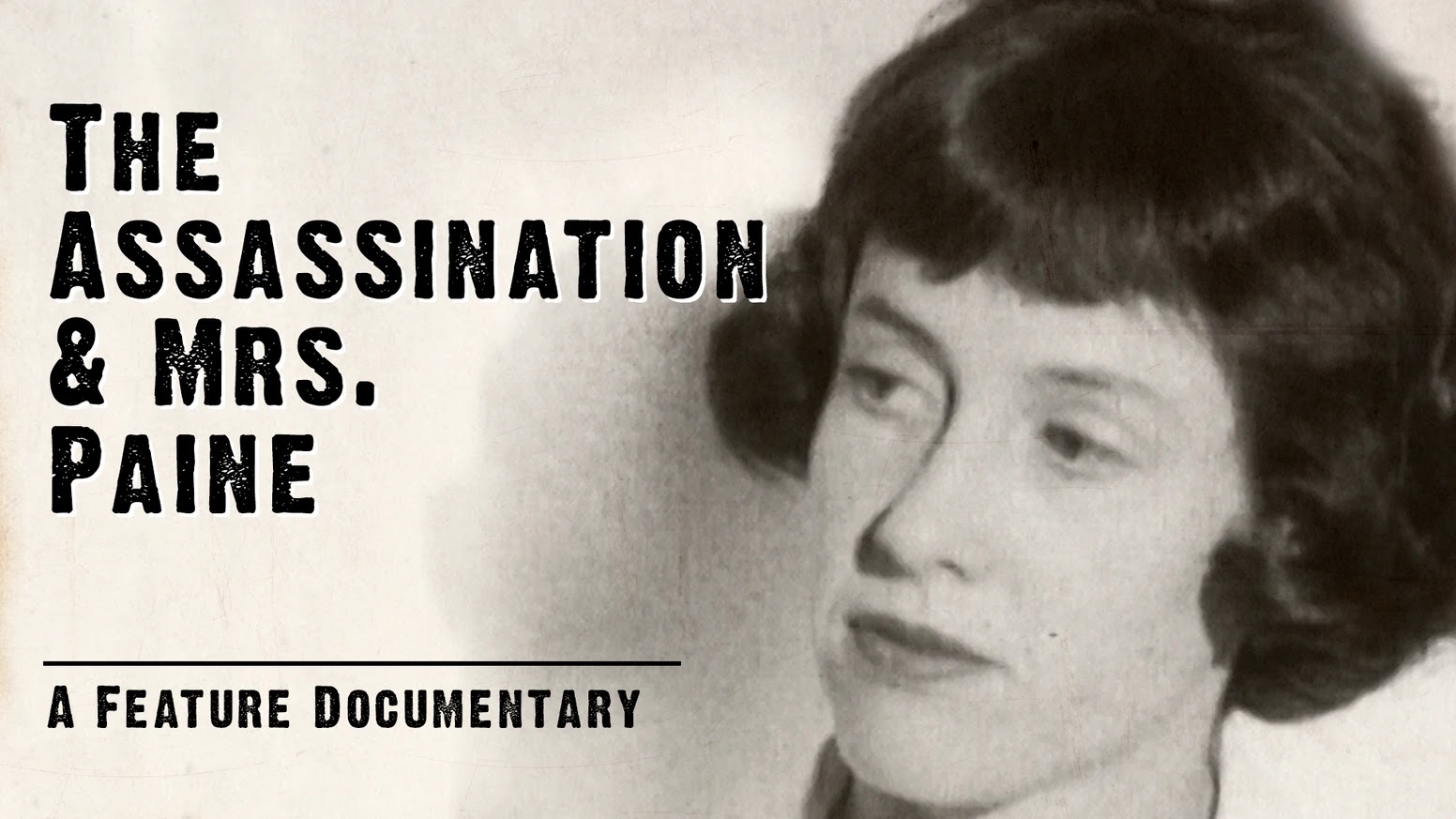
The Assassination and Mrs. Paine-George de Mohrenschildt

Filmmaker Max Good asks Ruth Paine, "Why would a white Russian [de Mohrenschildt] who was vehemently anti-communist asociate with Oswald?" "I don't know, good question," Mrs. Paine responds, "not one I asked." Good uses this exchange as a lead-in to a section on de Mohrenschildt and the unproven accusation that he too was a CIA asset involved in the assassination.

But a little research by Good could have satisfied his bewilderment regarding the Oswald-de Mohrenschildt friendship. George de Mohrenschildt was a world-class eccentric who specialized in doing things for no reason but to shock others. For instance, although he was an atheist, he liked to show up at two Russian Orthodox churchs just because he enjoyed singing in the choir. He was just as likely to attend a dinner party bare-chested or barefoot and another time in proper attire. Once, he gave a speech before Jewish friends claiming that Heinrich Himmler had "not been so bad." So, it seems a personality like de Mohrenschildt did not need a reason to befriend Oswald.

However, there are other explanations beyond de Mohrenschildt's eccentricity for his relationship with JFK'a future assassin. Friends of de Mohrenschildt asserted that he was not really a friend of Oswald but merely his benefactor as he was with several other down-on-their-luck individuals. Others who knew de Mohrenschildt said his relationship with Oswald was one of neccessity since the former had alienated many of his other friends in Dallas. Still others speculated that de Mohrenschildt understood Oswald's capicity for violence and used him to act out his own violent fantasies.

But perhaps de Mohrenschildt's own words offer the best explanation for their unlikely relationship. The following is from de Mohrenschildt's manuscript "I am a Patsy! I am a Patsy!" and describes his impressions upon meeting Oswald in Fort Worth:

He wore overalls and [had] clean workingman’s shoes on. Only someone who had never met Lee could have called him insignificant. ‘There is something outstanding about this man,’ I told myself. One could detect immediately a very sincere and forward man. Although he was average-looking, with no outstanding features and of medium size, he showed in his conversation all the elements of concentration, thought, and toughness. This man had the courage of his convictions and did not hesitate to discuss them. I was glad to meet such a person.

Despite such evidence, it is evident that Good buys into at least some of the arguments of people like James DiEugenio who is featured prominently in the film. But perhaps Good didn't know that DiEugenio is one of the least accurate scholars working in the JFK realm.

Predictably DiEugenio, accompanied by like-minded author Peter Dale Scott, appears on screen to accuse de Mohrenschildt of nefarious activity related to a CIA plot. DiEugenio maintains:

Shortly after this [presumably Oswald and de Mohrenschildt becoming aquainted] in about April of 1963, George de Mohrenschildt leaves the Dallas-Fort Worth area ... then he goes on to Haiti. And reportedly there is $300,000 deposited into his account.

For his part, Scott claims:

Before he went to Haiti he went to Washington and sat down in a secret meeting with Army Intelligence and the CIA, so you can see that de Mohrenschildt is somebody with a kind of spook background.

Back to DiEugenio:

So the question then becomes was de Mohrenschildt being paid off for doing his escort services with Oswald and then leaving them with Ruth and Michael Paine? That's a question we can't answer because, unfortunately, when the House Select Committee was trying to serve a subpenoa he was either murdered or took his own life with a shotgun blast.

DiEugenio's implication that de Mohrenschildt was murdered is the easiest to deal with. The Palm Beach County sheriff’s office, which investigated de Mohrenschildt’s death, concluded he died “by his own hand.” de Mohrenschildt had been suffering from mental illness for some time and his wife Jeanne had him committed to Parkland Hospital for psychiatric treatment in November of 1976—just months before his death. Jeanne stated that George "suffered from depression, heard voices, saw visions, and believed that the FBI and ‘The Jewish Mafia’ were persecuting him.” Even conspiracy theorist turned HSCA investigator Gaeton Fonzi believed that de Mohrenschildt committed suicide according to an interview he did with the South Florida Researcher's Group.

To deconstruct DiEugenio's allegation that de Mohrenschildt received $300,000 requires more effort and a review of original sources. But it is clear that there is no support for DiEugenio's statement in the film regarding a $300,000 deposit.

The first source is de Mohrenschildt's Warren Commission testimony when he stated that he pocketed $285,000 for the Haiti deal which included his performance of a geological survey on the island to plot oil and gas resources. But only $20,000 of the $285,000 was to be in cash. The remainder was to be paid in a ten-year concession on a sisal plantation. The Haitian Holding Company was formed by de Mohrenschildt specifically for the venture and included as partners B. Juindine Tardieu, a Haitian financier who was advisor to the Comercial Bank of Haiti, and Clemard Joseph Charles, who was president of the same financial institution.

The second source of information regarding the financial matters of de Mohrenschildt in Haiti came about as a result of the HSCA investigation in the late seventies. A stockbroker named Joseph Dryer told the committee that he knew both de Mohrenschildt and Charles when they were in Haiti in the early sixties. According to the HSCA, Dryer claimed that a woman named Jacqueline Lancelot, who was known to all three men, told him that a "person who handed out funds at the bank" had told her shortly after the JFK killing that $200,000 or $250,000 had been deposited in de Mohrenschildt's account in a bank in Port-au-Prince. The money in the account was thereafter paid out, although Lancelot did not know to whom, and de Mohrenschildt left Haiti shortly after.

Another source of information on de Mohrenschildt's Haitian finances is Edward Epstein's The Assassination Chronicles—specifically the 1992 edition. Epstein states that in 1981, he traveled to Port-au-Prince to try and nail down information about de Mohrenschildt's Haitian adventure. Epstein says that "one of de Mohrenschildt's close associates" at Charles' bank told him that while some of the deposits de Mohrenschildt received were for small amounts, there were "several large deposits" from a Bahamian bank with one exceding $200,000 (which is reminiscent of the HSCA report originating with Dryer). Epstein also refers to the planation that de Mohrenschildt had an interest in as a "derelict" operation and maintains that sources told him that he was in a "holding pattern" and did no real work. The implication is that de Mohrenschildt, who was said to be living in the same compound as President Duvalier, was recieving funds from somewhere and that "somewhere" was likely the CIA.

Finally, there is the 2012 book Our Man in Haiti by Garrisonite Joan Mellen which is a decidedly mixed bag when it comes to accuracy. On one hand, Mellen writes about a CIA document that refers to a Haitian government publication. This publication, which could be expected to be accurate in this instance, notes that the deal with de Mohrenschildt was for "$280,000" plus a ten-year concession on a sisal plantation. This is within $5,000 of what de Mohrenschildt told the Warren Commission. One the other hand, Mellen maintains that de Mohrenschildt "was known to have been involved in the Kennedy assassination, and connected with Lee Harvey Oswald ...." While the eccentric de Mohrenschildt certainly was "connected" to Oswald in the strictest sense of the word, his involvement in the JFK killing is unlikely in the extreme. Indeed, the Warren Commission stated there was "no evidence" linking either de Mohrenschildt or his wife to the assassination.

But even Mellen casts doubt on the large deposit promoted by the HSCA account and Epstein's anonymous source. Mellen writes that Dryer told her he "was certain that the figure was misinterpreted" by the HSCA and the "probable" amount deposited into de Mohrenschildt's account was only $50,000. Since $50,000 would be nearly half a million dollars in today's funds, an amount that Mellen sensibly says would "attract notice," it seems reasonable to conclude it is more likely the real sum was somewhere between $50,000 and the $20,000 that de Mohrenschildt maintained in his WC testimony.

Note too that Dryer provided Mellen with additional information about Jacqueline Lancelot who was the second-hand source for the allegation of a large payout to de Mohrenschildt. Mellen writes that while Lancelot "liked men," she "hated and distrusted de Mohrenschildt." "I’m scared of him," she reportedly told Dryer. "There’s something bad about him. He follows me around.” Lancelot also believed that de Mohrenschildt "had something to do with the Kennedy assassination.” Therefore, Lancelot's post-assassination claims to Dryer of large deposits in de Mohrenschildt's account could have been motivated by her animus toward him.

The bottom line is there is no source for DiEugenio's claim of $300,000. And both reports of a large cash deposit (Dryer's third-hand source and Epstein's anonoymous bank "associates") are anecdotal. Additionally, Dryer insisted that the HSCA had "misinterpreted" his report.

As for the Scott allegation, while he is telling Good the story of the "secret meeting," a newspaper article is displayed onscreen implying that this is the source supporting his allegation:

However, this article says nothing about a "secret meeting" between de Mohrenschildt and Army Intelligence or the CIA. It does state that de Mohrenschildt was a "CIA informant." But that is likely a reference to innocuous reports he gave to the agency's Domestic Contact Division (along with 25,000 other Americans) regarding his overseas activity. The HSCA checked out de Mohrenschildt and found that there was "no evidence" that he had "ever been an American intelligence agent."

de Mohrenschildt did meet with representives of both the CIA and Army Intelligence, but the meeting was more innocuous than theorists make out. The Army Intelligence official, Dorothe Matlack, arranged the meeting at the suggestion of fellow intelligence officer Sam Kail (of Maurice Bishop and Veciana fame). The purpose of the May 1963 meeting was to talk to, not de Mohrenschildt, but his partner Clemard Joseph Charles because of the latter's relationship to Haitian President Duvalier and that country's stratgeic position relative to Cuba.

At the meeting, Matlack was "surprised" by the presence of the uninvited de Mohrenschildt and his wife Jeanne. Matlack felt that de Mohrenschildt "dominated" Charles which is in keeping with other descriptions of the former's personality. For his part, Charles was a disapointment from an intelligence point of view and provided "no military information of value." Charles was "frantic and frightened" and wanted the US marines to invade Haiti and overthrow Duvalier likely because he was concerned about the expropriation of his business.

To sum up, the segment on de Mohrenschildt in Max Good's The Assassination and Mrs. Paine is one of the most misleading and least accurate in the entire film. And that is saying something.

Tuesday, June 7, 2022

The Assassination and Mrs. Paine-Ruth's Greatest Hits

A review of The Assassination and Mrs. Paine by John Seal noted that Ruth Paine "bats away [difficult questions by filmmaker Max Good and others] with impressive equanimity." Listed here are some of the times Mrs. Paine effectively answered her critics and/or persuasively argued the lone assassin case. My thanks to Greg Doudna for use of his partial transcript of the film.


Mrs. Paine: "The suspicion [about conspiracy in the death of JFK] comes from people who are looking for plots, and trying to figure out, you know, who or—it's so hard to feel that such a great man could be brought down so easily by such a small person. That’s really hard to take in."


Mrs. Paine: "It really illustrates how wrong that film [Stone's JFK] was or how ficticious it was because there we were but it was not us and not even our names" (Stone called the Paines "Janet and Bill Williams").


Mrs. Paine: "The people that are suspicious of me fortunately don’t really come around to talk to me. That does not happen and I’m grateful for that."


Mrs. Paine: "[commenting on her friend's belief in conspiracy] Yeah, well you're one of my liberal friends."


Mrs. Paine: "Well you’re [Max Good] making connections. My mother-in-law knew Allen Dulles. [speaking with feigned dramaticism] So obviously there’s a plot."


Mrs. Paine: "ABC did one of the best [documentaries on the assassination] which began by saying Oswald did it and they were going to show you why."


Mrs. Paine: "I didn't get into the conspiracies at all because I don't have a paranoid bone in my body. I just don't see ghosts anywhere."


Mrs. Paine: "He [Oswald] suddenly realized he had an opportunity to no longer be a little guy, but to be someone extraordinary."


Gerry Spence (represented LHO in a mock trial): "You did give the FBI a letter that was susposed to have been written by Lee to the Soviet embassy didn't you?"
Mrs. Paine: "This was a draft of a letter that he left on my desk ..."
Gerry Spence: "Yes."
Mrs. Paine: ... that concerned me very deeply because I could see that he was lying in it."
Gerry Spence: "He left ..."
Mrs. Paine: "And he'd used my typwriter and that offended me deeply [laughs]."


Mrs. Paine: "I learned a lot about what is written isn’t always true, in newspapers and magazines."


Gerry Spence: "Does it just happen as just a coincidence that you chose Russian as a language of your interest? That’s just a coincidence?"

Mrs. Paine: "No, it wasn’t a coincidence at all. I’m telling you that’s because I felt it was really important to communicate among—between our countries in particular. This was the era of the Cold War."


Good: "How do you feel about this stuff [rumors] proliferating on the internet?"
Mrs. Paine: "Well, I don’t look. That’s how I feel about it. I just live my life separate from that as best I can. I was surprised after there was a little article in the local paper about me. And some of the comments were horrible. Its an open internet. So—it has a lot of things that are not true."


Good: "I’ve been studying this case for the last few years, and tried to be objective, take in all different viewpoints."
Mrs. Paine: [skeptically] "Oh really? OK."
Good: "And try not to be too biased."
Mrs. Paine: "Shucks" (chortles).
Good: "It seems maybe a little extreme to completely dismiss the questions of conspiracy, with all that’s come out over the years?"
Mrs. Paine: "To you its extreme?"
Good: "Yeah."
Mrs. Paine: "To dismiss the idea of conspiracies? To me its not extreme. Because the things I saw were so telling. Everything I saw pointed to him [Oswald] and him alone."


Mrs. Paine: "Lee was, in my opinion, not somebody a spy agency would hire. I couldn't see him as connected to the Soviet Union. I think they were very happy to see him leave actually."


Mrs. Paine: "[commenting on Marina Oswald's recent belief in conspiracy] Wouldn't it be nice to think it wasn't he [Oswald] if you're the wife?"


Mrs. Paine: "My family had a hostility to communism, because my parents had been active in the cooperative movement—this is New York City—where the local Communist Party people wanted to take over. Part of the things I was raised up knowing is that the communists would think that the end justifies the means, and my folks didn’t feel that way at all, nor do I."


Good: "Maybe watching Oswald was a job you had to keep an eye on this ...
Mrs. Paine: "Flake."
Good: "... young communist defector who had returned."
Mrs. Paine: "Nonsense. Absolute nonsense."
Good: "Have you ever done any work for the FBI or CIA?"
Mrs. Paine: "[incredulously] No, I haven't. No, I was not Oswald's sitter for the CIA or whatever kind of story they're trying to tell. One of the things that I have felt very strongly is that it was important for me to answer questions and say what I knew because I'm interested in truth. I have really less and less patience with the people who are still looking for a conspiracy. It's great that we live in country that ... where people can put out their false notions freely-that doesn't happen in much of the world. And we can be proud that people can write books that are full of falsehoods and print 'em and not get jailed."


Mrs. Paine: "I'm a very independent person [laughs]. Nobody tells me what to do."

Monday, June 6, 2022

The Assassination and Mrs. Paine-JFK and the CIA

Filmmaker Max Good contends (23:10) that "Kennedy went along with the covert operation [Bay of Pigs] to overthrow Fidel Castro."

But no President just "goes along" with such an important operation. Kennedy could have canceled the mission at any time and he indeed made changes from Eisenhower's original plan which included moving the invasion landing site.

Good goes on to assert that "mistrust and resentment would mark Kennedy's relationship with the military and CIA for the rest of his life. After the Bay of Pigs fiasco, Kennedy remarked that he wanted to quote 'splinter the CIA into a thousand pieces'and he fired CIA director Allen Dulles soon after." But this is a one-sided representation of the facts by Good.

The infamous statement allegedly made by JFK regarding the destruction of the CIA never materialized until nearly three years after his death. The quote comes from an April 25, 1966 New York Times article:

And President Kennedy, as the enormity of the Bay of Pigs disaster came home to him, said to one of the highest officials of his Administration that he “wanted to splinter the C.I.A. in a thousand pieces and scatter it to the winds.”

But the official who susposedly relayed JFK's words to the Times has never been identified. This leaves open the possability that the anonomous official was merely using his own words to convey Kennedy's frustration after the Bay of Pigs failure.

But the best evidence that JFK never intended to break up the CIA comes from his actions after the Bay of Pigs. Just months after the failed invasion, JFK approved Operation Mongoose, a plan to get rid of Castro once and for all. JFK also used the CIA and tribal allies in Laos to "make every possible effort to launch guerrilla operations in North Vietnam with its Asian recruits."

Additionally, the susposed "mistrust" that Good thinks marked the relationship of JFK and the CIA goes against the findings of a 1996 agency study. The paper called "Getting to Know the President, CIA Briefings of Presidential Candidates, 1952-1992" was conducted by the deputy director for intelligence, John L. Helgerson. The study found:

... the [CIA’s] relationship with Kennedy was not only a distinct improvement over the more formal relationship with Eisenhower, but would only rarely be matched in future administrations ... in November 1961, Allen Dulles had been replaced by John McCone, who served Kennedy as DCI [Director of Central Intelligence] for almost two years. In the early part of this period, McCone succeeded in rebuilding the Agency’s relationship with Kennedy [after the strain caused by the Bay of Pigs]. McCone saw Kennedy frequently, and the President—more than any other before or since—would telephone even lower level Agency officers for information or assistance.

Indeed, a little less than two months before his death, JFK made the following comments regarding the CIA at a news conference:

I can find nothing, and I have looked through the record very carefully over the last nine months, and I could go back further, to indicate that the CIA has done anything but support policy. . . So I think that while the CIA may have made mistakes, as we all do, on different occasions, and has had many successes which may go unheralded, in my opinion in this case [South Vietnam] it is unfair to charge them as they have been charged. I think they have done a good job.

So while JFK may have been upset with the agency immediately following the Bay of Pigs and may have expressed his frustration, the evidence that he seriously considered abolishing the CIA is almost non-existent. Instead, he used the agency in covert operations in furtherance of his foreign policy goals. For more information see the excellent piece by Fred Litwin that discusses the "1000 winds" quote and other issues.

See also Mortal Enemies? at the late John Mcadams' site.

Saturday, June 4, 2022

The Assassination and Mrs. Paine-The "Secret Files"

Max Good's award-winning film ends with the following dramatic claim reminiscent of Oliver Stone's JFK:

But Robert Reynolds, a professor in the Department of Foreign Languages and Literature at National Chi Nan University in Puli, Taiwan and an expert on the JFK Assassination Records Collection, looked into Good's claim. He told me in an email about his methodology (Reynolds' quotes are in green):

"I looked for the total number of files related to the Paines that are still withheld or redacted. My basis for this was the most recent update of the JFK database from NARA (May 2021). Here's how I looked for Paine-related files. I checked records where the title, subject, series name, comments or "file number" fields had the string "PAINE" anywhere in them. I then checked the same fields for the names "HYDE" (Ruth's family name), and for "HOKE" (the family name of Ruth's brother-in-law, John Hoke, who married Ruth's sister Sylvia). I also did the same for the name "Bielefeldt," a CIA employee who was apparently a friend of John Hoke's father. Finally, I checked FBI records for all docs with the case file numbers for Ruth Paine (105-126128) and Michael Paine (105-126129)."

Note that Reynolds omitted any tax-related files from his analysis since these are not subject to release by law. What was the result of Reynolds' research?

"I found lots of records using the name Paine, but only one document with the name Paine which still had redactions. This was a 12/05/63 memo. There are several copies of this memo in the ARC, here is an example. There is only one name redacted in this memo, someone on the CIA's Counterintelligence staff who provided info to the FBI about Ruth's father which they obtained during a 1950s investigation. That's it. For the name Hyde, only the 12/05/63 memo mentioned above came up with redactions."

"For the name Hoke, one more relevant record came up in the updated JFK database. Ruth's brother-in-law John Hoke applied for a position at the CIA and his application papers are in the ARC. This doc is a poor quality copy, but we can see that Hoke was not hired. The only redactions in this record are the names of a couple of CIA staff members who reviewed his application."

"Searching on the case file numbers for the Paines, there are four FBI records still redacted; three on the Paines' 1964 tax returns and one on their 1957 tax returns. These are redacted, not withheld in full according to the JFK database, so some of this material may be accessible. All the other records with the Paine case file numbers are released: 'open in full'."

"After my original post [to a JFK email group], I also found three more records relating to John Hoke that still have redactions, but which did not turn up in the Paine/Hyde/Hoke searches. These are 104-10120-10303 to 10305. These are all requests from CIA technical services to consult with Hoke, who at the time was employed in the Agency for International Development. To talk to him, they had to first get approval, and on these three forms the name of the person(s) who approved the request to consult with Hoke is redacted."

"Total: Ruth Paine: one document (multiple copies) has one name redacted. Michael Paine: zero documents redacted. John Hoke: four docs have CIA employee names redacted. All other documents for the Paines which are still redacted/withheld are tax related" (emphasis added).

My thanks to Robert Reynolds for his work on this matter. It would seem that Max Good should provide either links to the "dozens" of files he claims are "classified" or issue a clarification or retraction.

Addendum 1: Robert Reynolds just (6/4/22) sent me the following:

It has gone over my head all this time that the final screen of the Max Good film ends with a claim that "dozens of files related to the Paines remain classified." It is worth underlining that while the Paines' tax returns in the JFK collection are withheld from the public, they are NOT classified. ALL individual tax returns are withheld from the public, as mandated in the U.S. federal tax code. This has nothing to do with security classification (emphasis in original).

Addendum 2 (6/4/22): There has been talk on Internet forums about "other" documents besides those in the JFK Collection that remain unavailable to researchers. Robert Reynolds answered these concerns:

Two possible answers. They may be thinking of documents which are NOT held in the JFK collection at NARA. I can't say anything about those. It's a big world out there with lots of paper in it to write things down on.

IF they are thinking of documents in the JFK collection, that is a different story. The collection is known. It is numbered like the tribes of Israel in the Book of Numbers. Not every word in the collection is accessible to the public, but every word IS accessible to the people at NARA who have charge of the collection. (None of these people work for the CIA.)

What is not accessible to the public? There is a lot of confusion about this. There are documents withheld and documents missing and documents redacted. 515 records in the Collection are withheld. In full. With the exception of the Manchester interviews with JBK and RFK, all of these docs have been seen multiple times by the WC, the HSCA, the ARRB and those lucky dogs at NARA. They are almost all tax records.

There are 33 records in the collection that are "missing." There is a page up at NARA on these. If you believe NARA, nothing Paine related is there. If you don't believe NARA, please explain why. But you have to buy me a six pack of beer first.

NARA also says there are 14,236 records with redactions in the collection. People need to get this straight. These records are OPEN to the public in copies that have bits blanked out. Almost all of these were put online 2017-2018. You can look at them any time. I've looked at all of the CIA ones, some of the FBI ones. It was incredibly boring. The blanked bits are for the most part single names or locations. There is nothing there on the Paines. The bit blanking leaves more than enough context to show this. Look for yourself.

Friday, June 3, 2022

The Assassination and Mrs. Paine-Earl Warren

Introduction

Filmmaker Max Good tries to give the viewer the impression that his documentary, The Assassination and Mrs. Paine, tells both sides of her unique story. While Good does let Ruth Paine speak (and she frequently counters his assertions) he uses a mixture of standard conspiracy myths and his own misrepresentations to support the notion that Mrs. Paine and her husband Michael, who befriended Lee Harvey Oswald and his wife Marina, were working for the CIA. This shows that Good believed he had no marketable film without catering to die hard conspiracy believers, the majority of whom believe the men of Langley were behind JFK's murder. This series of articles will document the inaccuracies of the Good film and the sometimes mean-spirited way that Ruth Paine is represented.

Earl Warren

Good presents archival footage of Earl Warren and his fellow Warren Commissioners delivering their final report to President Johnson in September of 1964 (9:40). “In 1964,” Good intones, “Earl Warren was asked if the commission’s documents would ever be released to the public.” Good continues, “His answer? ‘Yes, there will come a time. But it might not be in your lifetime.” The uninitiated viewer is left with the impression that Warren made this statement at the time the report was issued and his remarks were indicative of his intention to withhold material. But that is not the truth.

Warren actually made his remark after the first day of testimony in February of 1964—not after the September release of the report. Warren’s full remark was “Yes, there will come a time—but it might not be in your lifetime. I am not referring to anything especially—but there may be some things that would involve security. This would be preserved but not made public.” Warren also indicated that nothing like this had yet turned up in the testimony of Marina Oswald who was then appearing before the commission. Author Vincent Bugliosi summed up the matter as follows in his landmark tome Reclaiming History:

This one remark, always quoted out of context, is the source of the belief that Earl Warren, knowing all the testimony and evidence that had been heard and gathered by the Warren Commission during its ten months of existence, had come to the conclusion that certain evidence should not be revealed to the American public for seventy-five years, and that he therefore ordered the sealing of the records for the subject period.

But Warren ordered no such sealing of records. Bugliosi noted that the Chief Justice wrote to Attorney General Katzenbach asking for “fullest possible disclosure of the materials” which were under jurisdiction of the National Archives. As early as July of 1966, approximately 80 percent of the records from federal agencies that had been turned over to the archives by the commission had been released. Today, the number of JFK documents released, including those identified as assassination records in the nineties by the ARRB, totals in the millions.

Monday, May 16, 2022

Thursday, April 21, 2022

Response to Kelly re: "HSCA Evidence of Conspiracy"

Researcher Bill Kelly recently published a blog article that attempts to debunk the “Lone Nut factoid” that “the only evidence of conspiracy that the HSCA came up with was the acoustical study, that has since been debunked.” Apparently because he is unhappy with my eBook, The Bishop Hoax, Kelly chose to focus his wrath on me.

Kelly writes:

Parnell tried to contest [Brian] Bennder’s (sic) mentioning the fact that the House Select Committee on Assassinations (HSCA) conclusion that there was probably a conspiracy in the assassination of President Kennedy, saying the only evidence of conspiracy that the HSCA came up with was the acoustical study, that has since been debunked.

The problem is, I never said this. What I did say is that the conclusion by the HSCA of a probable conspiracy was based primarily on the now debunked acoustic evidence.

The first draft of the HSCA report dated December 13, 1978, states:

The committee finds that the available scientific evidence is insufficient to find that there was a conspiracy to assassinate President Kennedy.

In his dissenting view to the final HSCA report (HSCA, 495), Robert W. Edgar noted:

Up to that moment in the life of the committee, we were prepared to go to the American people with that conclusion. Only after the report of Mark R. Weiss and Ernest Aschkenasy, in the 11th hour of our investigation, was the majority persuaded to vote for two gunman and a conspiracy. I respectfully dissented.

Indeed, the HSCA report listed four factors that led to the conspiracy conclusion:

(1) Since the Warren Commission's and FBI's investigation into the possibility of a conspiracy was seriously flawed, their failure to develop evidence of a conspiracy could not be given independent weight.
(2) The Warren Commission was, in fact, incorrect in concluding that Oswald and Ruby had no significant associations, and therefore its finding of no conspiracy was not reliable.
(3) While it cannot be inferred from the significant associations of Oswald and Ruby that any of the major groups examined by the committee were involved in the assassination, a more limited conspiracy could not be ruled out.
(4) There was a high probability that a second gunman, in fact, fired at the President. At the same time, the committee candidly stated, in expressing it finding of conspiracy in the Kennedy assassination, that it was "unable to identify the other gunman or the extent of the conspiracy.

But it is obvious that the first three factors listed by the committee were known to them at the time of the first draft and were not persuasive enough to lead to a finding of conspiracy. As noted by Edgar, it was only the “high probability” of a second gunman by way of the acoustics evidence that caused the committee to change its mind.

Kelly also notes that:

And the acoustical echo analysis, though often disputed, has never been debunked because the only way to prove or disprove a scientific study is to repeat it, and the HSCA acoustical echo analysis has never been duplicated.

Of course, this is nonsense. All that is needed is to show that the methodology of the original acoustics study was flawed and this has been done again and again. To date, the best summary of the problems with the acoustics data comes from Nicholas Nalli in his article The Ghost of the Grassy Knoll Gunman. Nalli draws on the work of noted acoustics critics including Dale Myers, Michael O’Dell and Steve Barber.

In addition to his misrepresentation of my position on the HSCA conspiracy findings, I have a few other problems with Kelly’s piece. He writes:

Parnell, one of the numerous die hard lone nutters who still try to contend the President was killed by a deranged loner for no apparent reason …

Again, I have never said that Oswald killed JFK for “no apparent reason.” In fact, I know of no “lone nutter” who has stated this. The Warren Commission did write that they “could not make any definitive determination of Oswald's motives.” Since Oswald was dead, this seems very reasonable. But they did, in fact, list several “factors” which “might have influenced his decision to assassinate President Kennedy.” They were:

  • His inability to enter into meaningful relationships with people, and a continuous pattern of rejecting his environment favor of new surrounding;
  • His urge to try to find a place in history and despair at times over failures in his various undertakings;
  • His capacity for violence as evidenced by his attempt to kill General Walker;
  • His avowed commitment to Marxism and communism, as he understood the terms and developed his own interpretation of them; this was expressed by his antagonism toward the United States, by his defection to the Soviet Union, by his failure to be reconciled with life in the United States even after his disenchantment with the Soviet Union, and by his efforts, though frustrated, to go to Cuba.

My own vote goes to “a place in history,” although any or all of these could be correct.

Back to Kelly as he turns his ire toward my book:

And a point that I don’t expect Parnell to address in his mythical interpretation of Antonio Veciana’s story, is how David Atlee Phillips, as Maurce (sic) Bishop, took Veciana to an office in the Pan Am Bank building in Miami in order to sign a security oath and begin his lessons in psychological warfare.

But Kelly has his Veciana stories mixed up, which is understandable considering their nonsensical nature. The training Veciana supposedly received was in Havana not in Miami. What was ostensibly at the Pan American building was a Knights of Columbus-like “commitment ceremony.” But the CIA has no such ceremony although they do have real agency employees sign a secrecy oath. But an examination of Veciana’s actual CIA paperwork created when he was an (unused) asset of sorts for a short period starting in 1961 shows no such oath and no evidence of CIA employment.

Finally, Kelly writes:

[Lopez and Hardway] also went to Mexico and wrote the long censored Lopez Report, that details many of the conspiracy leads that Parnell won’t even recognize. Both Lopez and Hardaway, to this day, are dedicated and proud conspiracy theorists.

Dan Hardway may or may not be a “dedicated and proud” conspiracy theorist. But he definitely is the person who became so skeptical of Veciana’s claims that he asked John Newman to look into them. Newman found that both the 1959 and 1960 stories of how Veciana met Bishop are false if you believe Bishop was David Phillips. Summing up, Kelly promises to “get to” my book with a rebuttal. That is fine with me, but I hope in the future he will not mischaracterize my views as he has done in this latest blog article.

Powered by Blogger.