Tuesday, December 6, 2022

Morley's Bombshell a Dud

JFK researcher Joseph Backes said yesterday (December 5th 2022) that he hoped Morley wasn't "over selling" his latest assertion regarding the JFK assassination and a "smoking gun" that he thinks is in some unreleased files related to CIA officer George Joannides. But over selling wasn't a strong enough term for what Morley did during a press conference for the Mary Ferrell Foundation. In fact, he seriously misrepresented what this gathering would show. Morley, who hinted at a "smoking gun" and a "major break" in blog posts, presented exactly no new information to back up his claims of an alleged "Oswald Operation" managed by the CIA. And Morley did not name or even mention the "living witnesses" who will supposedly lend credence to the existence of the operation. Admittedly, Morley did not specifically say that the witnesses would be discussed, but he did say the evidence would be coming "in the near future" and it was logical to assume it would be at this presser.

What follows is a quick summary of the press conference. I may do another blog post if documents on Joannides are released on December 15th. If not, I may let the matter rest since Morley provided no new proof for his theories which have been discussed at length.

Morley, a gadfly and far-left blogger who says he has been studying the assassination for 28 years by his own count, originally presented himself as an agnostic on the JFK matter who was merely interested in the truth—whatever that might be. But in recent years, it has become apparent that he is indeed a full-fledged conspiracy theorist who believes (among other things) that JFK’s enemies “made Oswald a patsy for their crime” as he wrote in an eBook. Why care what Morley thinks? Because as a former editor/reporter for the Washington Post, he still commands attention and has been published by the likes of Newsweek and Politico. I have written extensively about Morley and I am not alone. You may see a listing of the pieces critical of Morley HERE.

Morley was joined at the National Press Club in Washington DC by a cast of characters who disagree on just about all aspects of the JFK case. Rolf Mowatt-Larssen, who appeared by video, believes that "Oswald was recruited into a rogue CIA plot." Morley admits that he doesn't "entirely agree" with that. Similarly, Lawrence Schnapf, an attorney who served as moderator for the confab, thinks that the Mafia killed Kennedy. Schnapf likely doesn't believe in Morley's theory any more than I do. Judge John R. Tunheim, who was Chairman of the Assassination Records Review Board tasked with overseeing the records, almost certainly doesn't believe in a conspiracy at all and simply wants the remaining JFK records released. Fernand Amandi, a political analyst for MSNBC who presented the results of a meaningless poll, thinks among other things that proven hoaxster Antonio Veciana was “one of history’s most important individuals” and therefore can be dismissed outright.

Schnapf opened the event with the well-worn mantra "what are they hiding?" Schnapf handed off to Mary Ferrell's Rex Bradford who it should be said is a talented individual who created the database that the Mary Ferrell Foundation uses. Unfortunately, Bradford repeated two well-worn myths during his brief remarks. One is the remark made by Earl Warren regarding "not in your lifetime" explained HERE. The second unfortunate remark made by Bradford was that at the time of JFK's death, he was committed to fully withdraw from Vietnam. This statement is false and is discussed HERE.

Judge John Tunheim followed Bradford and his remarks primarily consisted of what the Assassination Records Review Board did and his belief that the records should be released. Tunheim did note that he had seen the records and there were "no bombshells." Tunheim also mentioned that the Walter Sheridan files held by NBC should be released.

Schnapf returned to the podium and noted that even if all of the records are released by Biden that would not be the end of the lawsuit filed by him and Bill Simpich since there are other records that should be in the JFK collection that are not. Schnapf then introduced Morley and the main event proceeded.

Rather than naming his "living witnesses" and demonstrating their relevance to his hypothesis, Morley proceeded to regurgitate the same tired theories he has been promoting for years under the umbrella of what he is now calling the Oswald Operation. Morley made use of an audio-visual presentation to dramatize his thesis which is summarized by these bullet points:

  • There was a covert operation involving Oswald in the summer 1963.
  • The Warren Commission was duped by CIA who was monitoring Oswald via Angleton.
  • Deception operations were used in 1963 including COINTELPRO, Northwoods and the targeting of the Fair Play for Cuba Committee.
  • Oswald's FPCC chapter was targeted for disruption.
  • Oswald was represented as “Pro-Castro gunman” by the news media.
  • The hidden hand of the CIA shaped the media's narrative and thus public understanding regarding Oswald.
  • The CIA funded the DRE and George Joannides was their case officer.
  • The "Oswald Operation" was cleared to begin in June of 1963 and documents indicating this fact are being withheld.
  • Joannides was cleared for "special intelligence" which Morley says means wiretapping.
  • This is significant according to Morley because the CIA was wiretapping FPCC leaders at the time. Within two months, the DRE would generate propaganda about Oswald in New Orleans and in Mexico City, Oswald was monitored by a wiretap.
  • The Oswald Operation was implemented in August of 1963 with Joannides playing a supporting role. The well-known interactions between Oswald and the DRE occurred during this time.
  • "What a difference 30 days makes" Morley intoned during this part of the presentation. Before Joannides took over the DRE on August 1st, Oswald had no public record as a Castro supporter. But 30 days later, a legend had been created according to Morley. But Morley doesn't explain the statements of Oswald's wife Marina who said he idolized Castro or the remembrances of fellow Marine Nelson Delgado (and others) who recalled Oswald speaking glowingly of Castro back in late 1958.
  • Morley says that COINTELPRO used techniques like he believes were used against Oswald including the planting of deceptive information, leaking negative information and the use of law enforcement to harass or arrest individuals.
  • CIA headquarters didn't mention Oswald's arrest in New Orleans when asked about him by Mexico City Station because of the ongoing operation.
  • The secret campaign against FPCC succeeded culminating with the disbanding of the group in the US.
  • Documents concerning Joannides cover and methods during 1964 are still withheld.
  • The HSCA didn't know that Joannides was the DRE case officer when he served as CIA liaison to that body.
  • Why did Joannides receive a CIA medal after stonewalling investigators. This is a moot point since Morley knows that it was for career service.
  • The CIA is hiding 44 documents regarding Oswald that include a secret CIA operation that has never been disclosed.
  • The term "smoking gun" is disliked by Morley and he admits not used by investigative reporters but he uses it anyway. But Morley admits that what he is talking about is not "smoking gun" proof of a conspiracy to kill the President. Rather, it is "smoking gun" proof of a CIA operation involving Oswald that the agency is still concealing in 2022. "Is the undisclosed Oswald operation evidence of CIA complicity in JFK's assassination?" Morley muses. "Is it evidence of incompetence in understanding the threat Oswald posed to the President?" Only full disclosure of the records can resolve these questions Morley insists.

There are several problems with Morley's analysis. First, he has no proof that there was an Oswald operation at all. He merely has suspicions. If he has any witnesses, they did not appear and were not mentioned. Next, Morley believes that Oswald was "made a patsy." So, why does he leave open the possibility that the CIA was merely incompetent? Is he now willing to be proven completely wrong if the records indeed show the CIA had nothing to do with Oswald and only minimal knowledge of him? Finally, the overwhelming evidence shows that the DRE was not directed by the CIA to do the things they did regarding Oswald. As anti-Castro activists, they did not have to be. In fact, they often disobeyed CIA orders and finally were defunded because of that fact.

But the main problem for Morley is that Michelle Combs of the ARRB saw the complete Joannides file and found no evidence of any Oswald project. I am sure Morley and his followers would say that Ms. Combs did not have the proper background to determine what she saw. But presumably if there was a project that empowered the DRE to run an operation against Oswald at the CIA's behest, it would be pretty obvious even to those not steeped in JFK assassination lore. And evidently, Ms. Combs did not find such a project. She reported:

During the period December 1962 to April 1964, Mr. Joannides was assigned as a covert action officer at JMWAVE, serving as deputy and then chief of the station's covert action branch. During this time period, Mr. Joannides was the case officer for the Cuban exile group Directorio Revolucionario Estudiantil (DRE). The descriptions of his duties and accomplishments in the personnel file are very general and contain no specific reference to his relationship with the DRE. There is no mention of the assassination of President John F. Kennedy in the file and no information relevant to the assassination in the file (emphasis added). There is also no indication that Mr. Joannides may have used or been known by the name "Howard" during his contacts with the DRE, although personnel files typically would not reveal this information one way or another.

So, the bombshell was a dud and a ploy to gain media attention to the cause of opening the files. If Morley produces his "evidence" of the alleged "Oswald Operation," this blog will report on it.

Monday, December 5, 2022

Morley Says Major Break in the JFK Case Coming

Conspiracy theorist and gadfly Jefferson Morley is promising a "major break" in the JFK assassination "story." But those who have been following him for some time knew he would eventually do this. He had to.

The "major break" will be announced at a press conference at the National Press Club in DC. The "break" evidently consists of witness statements (a staple in the relm of conspiracy "evidence") that there was "a covert operation that used Lee Harvey Oswald for intelligence purposes" which was approved by "senior agency officials." I say that the witness statements must be the proof of Morley's operation since the documents that he insists "tell" the "explosive" story remain unseen and Morley doesn't have any idea what they say.

Morley has been running around in recent years saying the CIA was complicit in the JFK murder after originally presenting himself as an agnostic who just wanted the truth. But when you make all of the noise that he has over the years, you must put up or shut up at some point. He certainly isn't the type to say, "Gee, I was wrong." Morley evidently believes that if he claims there is a smoking gun that Biden or a later President will be forced to act and release the records which relate to Morley's preferred villian CIA officer George Joannides.

But skeptics have appeared on the conspiracy side of the debate even before the alleged bombshell announcement. Joseph Backes, a prominent conspiracy researcher, is worried that Morley is "over selling" the records and building expectations "too much." Backes alludes to the diversion of opinion in recent years bewteen Morley and John Newman who believes that the primary conspirators were military people. Backes also sensibly says that he doesn't believe the theories of Rolf Mowatt-Larssen, a former CIA employee who will speak at the press conference.

Time will tell if Morley has solved the case or if his gambit will go down with Roscoe White as a bad hoax. But Morley has a backup plan. If the records are released and don't show what he says they do, he can simply say that the CIA destroyed the proof and his witnesses confirm that "fact."

Thursday, August 4, 2022

The Assassination and Mrs. Paine: Behind the Curtin

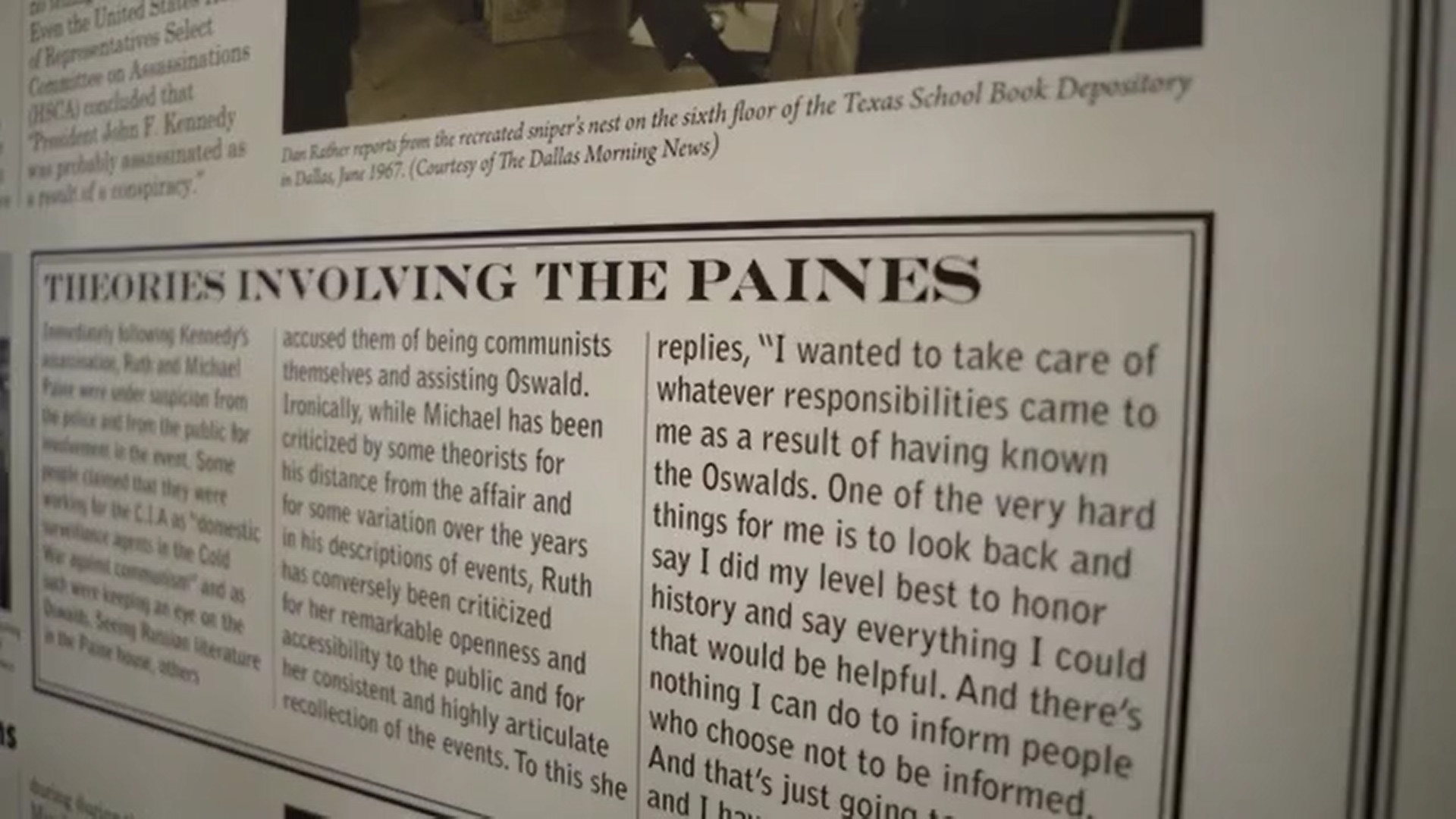
Edward Curtin says that he is very concerned about "human duplicity." So much so that he has written a book about it called Seeking Truth in a Country of Lies: Critical & Lyrical Essays. Seems like a noble cause. That is, until you look behind the curtain, which is what his website claims he himself does, at his review of Max Good's film The Assassination and Mrs. Paine. Good himself has promoted the review as "thoughtful."

But the ostensible truth seeker Curtin spreads so much misinformation in this review that it is difficult to know where to begin. However, a look at Curtin's world view is instructive. Curtin believes that "all" of the mainstream media—CBS, ABC, The Washington Post, etc.—"speak for the Central Intelligence Agency." Curtin says that "many journalists and academics hold dual positions, since they secretly work as assets for the intelligence services."

Notably, Curtin completely agrees with the late Vincent Salandria who he believes was one of the "most brilliant critics of the official story." A quote from Salandria that Curtin finds significant enough to blockquote in his review is the following:

There is no mystery here. It’s all self-evident. It was a coup. It was designed to be a false mystery and the debate would be eternal and why (emphasis by Curtin) it [killing JFK] was done – forgotten. In order to commit yourself to truth here, you’re changing your real identity from a citizen of a democracy to a subject of a military empire. A big step.

Having ascertained where Curtin is coming from, let's take a look at the misleading and inaccurate statements (highlighted in green) from his review and my responses. Because, as Curtin says, "Human duplicity is a marvel to contemplate."

"...a good number of the people who appear in The Assassination and Mrs. Paine have no ostensible institutional affiliation but may be working in some capacity for an invisible institutional paymaster who calls their tunes. No names required."

Curtin doesn't want to mention names for legal reasons but he is obviously talking about Ruth Paine, Max Holland and Gerald Posner among others. In response to Curtin's qualified assertion, I will simply quote Max Holland from Good's film:

A favorite tactic of conspiracy theorists is to make accusations that anybody who they disagree with has a connection with the intelligence community. It's been made against me, it's been made against Ruth and Michael. The only explanation could be that we’re part of the coverup, paid by the CIA ...

Curtin, by the way, is one of those who has proven Holland's point for the umpteenth time just since the film was released in June.

"Her [Ruth Paine's] testimony led to the WC’s conclusion that Oswald, and Oswald alone shot, the president."

One hundred percent false. See complete discussions of the subject here and here. What led to the WC conclusion that Oswald was the lone assassin was the overwhelming evidence they uncovered. The vast majority of that evidence has nothing to do with Ruth or Michael Paine.

"The Assassination and Mrs. Paine is Max Good’s second full-length documentary. He came to the subject after reading a section (pp.168-172) on Ruth and Michael Paine in James W. Douglass’s JFK and the Unspeakable: Why He Died & Why It Matters, a book considered by many to be the best on the JFK assassination."

See the late Professor John McAdams' demolition of Douglass here.

"she [Ruth] agreed to be interviewed, something she has done for 59 years, always protesting her innocence even though over the decades researchers have uncovered much evidence to the contrary."

"Researchers" have uncovered precisely NO evidence that Ruth was guilty of being involved in a plot to kill JFK or a plot to cover-up such a conspiracy. What they have "uncovered" is many people who are suspicious of her. The reason these individuals are suspicious is that they believe there was a conspiracy to kill JFK and Ruth's first-hand experience with Oswald must be explained away in an expedient manner because it doesn't fit into any of their theories.

"The Paines, who have claimed they are pacifists, might best be superficially described as unassuming, liberal Quaker/Unitarian do-gooders, whose wealth and astounding family and intelligence connections would make heads spin, if they were known. The film exposes many of those connections."

Unfounded doubts about the sincerity of the Paines religious beliefs are discussed here. The fact that Michael Paine came from a wealthy family and both Ruth and Michael have "connections" that theorists find suspicious were not "exposed" by Max Good. These facts have been known for years.

"The fundamental undisputed facts are as follows. In February 1963, Ruth, who spoke and taught Russian, was invited to a party by George de Mohrenschildt, a White Russian CIA asset who was ‘babysitting' Lee Harvey Oswald at the request of the CIA. There she met Oswald."

Curtin's "undisputed facts" are anything but. It was not de Mohrenschildt but Everett Glover who invited Ruth to the party. And Curtin's assertion that de Mohrenschildt was "babysitting" Oswald stems from his interview with journalist Edward Epstein which occurred when the baron was suffering from a demonstrable mental illness. It should also be mentioned that de Mohrenschildt was being paid by the Reader's Digest for the interview and he undoubtedly wanted to give Epstein something new for his money. J. Walton Moore, the Domestic Contact employee who de Mohrenschildt knew, denied that he had spoken to the baron about Oswald. Read much more about de Mohrenschildt and the suspicions of theorists here.

"On her long road trip south, she made numerous stops, including at her sister Sylvia Hyde Hoke’s house in Falls Church, Virginia. Sylvia worked for the CIA, as documents have confirmed, and her husband worked for the agency’s front, the U.S. Agency for International Development..."

Since Curtin likes facts, here are a few. Ruth's father and brother-in-law probably worked for USAID. But not everyone in USAID is secretly working for the CIA. And the fact that Ruth visited her sister while on a road trip is hardly newsworthy. There is no credible evidence that Ruth ever worked for the CIA as an agent or asset. And there is no evidence that any family member was feeding her instructions from Allen Dulles.

"...yet to this day – and in Good’s interview in the film – she claims not to know where her sister worked."

Ruth "to this day" is completely aware that her sister worked in an evidently non-covert capacity for the CIA. Why would she not be—Good showed her documents that proved it. But Sylvia Hoke was undoubtedly not broadcasting her relationship with the agency and it seems that while Ruth was aware that her sister was employed by the government in some capacity, she never pressed the issue further.

"In mid-October, again out of alleged kindness, she got Lee a job in the Texas School Book Depository, despite calls to her house from an employment agency offering him a much higher paying job. When asked about this by the Warren Commission, Ruth gave an evasive answer."

Researcher Greg Doudna has addressed this issue here. The short version is that it is unknown if the man from the employment office told Ruth that the prospective job paid more than the one Oswald had just taken at the Texas School Book Depository. But theorists like Curtin will undoubtedly continue to say that she knowingly withheld this information even though they can offer no proof of it.

"Then when JFK was killed, an empty blanket roll that allegedly held Oswald’s rifle was found in the Paines’ garage."

Ruth knew nothing of the rifle or the blanket roll that held it. That information was provided to the authorities by Marina Oswald.

"And Ruth claimed to have found a note – the ”Walker Note” that was used to show his propensity for violence – and a letter also allegedly written by Oswald to the Russian Embassy that was used as evidence of his guilt."

The Walker note is discussed here. Both the signature on the letter that Oswald wrote to the Soviet embassy and the draft that he worked from were confirmed by handwriting experts to have been written by him. In any case, the letter merely helped to confirm his presence in Mexico and did not establish his "guilt" in the JFK, Tippit or Walker shootings.

"The Paines have always said that Oswald killed Kennedy to make a name for himself – the little man kills the big one syndrome. They repeat this in the documentary. Ruth says of Oswald, “He realized he had the opportunity to no longer be a little guy but someone extraordinary.” But as Jim DiEugenio (one of the finest and most informed commentators in the film) says, if that were so, then why did Oswald always claim he was innocent, a patsy who didn’t shoot anyone. Those who wish to kill to make a name for themselves obviously claim credit, but the Paines seem not to get this. Their claim makes no sense, yet they both repeat it in the film."

What would make no sense would be Oswald incriminating himself in a death penalty state. There was no need for him to declare that he was guilty to "make a name for himself." Every news camera and every reporter in the world was already focused on him. By he way, Jim DiEugenio has a poor track record as a JFK scholar.

"Paine’s defenders make sure to bash Oliver Stone and his film, JFK..."

Stone's film was universally bashed by just about everyone in the know. Read about it here.

"Bill Simpich interjects that there is “something about the Ruth Paine story that simply doesn't jell.” Good then proceeds to ask Ruth a series of hard questions that viewers will find very interesting. But he never lets the audience know what he has concluded about her guilt or innocence. He is impartial to the end."

Nonsense. Good has stated in interviews that the book that began his JFK research was Douglass' JFK and the Unspeakable. And that volume is certainly critical of the Paines. In addition, I have done a study of the objectivity of the film and concluded that it is clearly slanted toward the conspiracy side.

Interestingly, in a recent interview with the San Antonio Express News, Good stated that he had reached some conclusions about the Paines which he "intentionally" left out of the film. "...I decided not to reveal what my conclusion is, at least for now," Good explained, "because I think the film’s more powerful when people watch it and they have to be on their toes wondering and thinking about who they trust."

But when pondering the possibilities, Good's "conclusions" seem to be limited to three. I credit much of the following to an email discussion with noted researcher Paul Hoch. First, Good could believe that Ruth had nothing to do with a conspiracy. But in that case, how could he justify publicizing some of the irresponsible remarks by DiEugenio, Salandria and others? Secondly, he could believe Ruth is guilty of something. But then how and why can he continue to maintain that his film is truly balanced? The "why" may be partly explained by the fact that Good does not want to be perceived as just another conspiracy theorist even though he must maintain a relationship with more extreme individuals whom he may not agree with. Keeping his own position under wraps skirts the issue for now.

But I am putting my money on a third theory that I'll call the Jefferson Morley approach. Good believes there was a conspiracy and the Paines must fit into it as Salandria told him. But Good (along with a million other theorists) hasn't quite figured it all out yet. And his search for JFK knowledge gives him the perfect excuse for a sequel (or a series of them) just as it has provided Morley with a reason to pen five books related to the subject. Because conspiracies, which are really just historical mysteries, sell.

Edward Curtin and Max Good say (or at least imply) they are seeking truth in the matter of Ruth and Michael Paine. The reader can decide if they have found it or if they have muddied the waters even more than they were.

Thursday, July 28, 2022

The Assassination and Mrs. Paine--Part Two: Did Ruth Incriminate LHO?

Continuing the discussion regarding items that theorists believe “Ruth [Paine] and her garage provided” to incriminate Lee Harvey Oswald, consider the following Max Good narration from his film The Assassination and Mrs. Paine:

Good (1:15:40): Two weeks after the assassination, as doubts about Oswald's trip to Mexico were surfacing, Ruth miraculously found several incriminating items sitting in a drawer in the room where the Oswalds had stayed.

Before examining the evidence in this matter, a question must be asked. Since the Oswalds used Ruth's house to store many of their personal belongings, what is so "miraculous" about any particular item being found there? Ruth explained in her Warren Commission testimony how these specific items were found:

"And it was not then until perhaps a week or something less after the assassination when an FBI agent asked me was there anything left in the house that would be pertinent, and he and I went together and looked in the drawer in the room where Marina had been staying, and found there [the items Good shows among others]."

What was "incriminating" about these items? Good and his fellow theorists don't say. For instance, there was not a gun found among the items but rather innocuous objects which included coins, postcards, a bracelet and a Spanish-English dictionary. One of Good's "featured" experts, James DiEugenio, said this about the items in his book Destiny Betrayed:

...the Commission now had some corroboration for a trip to Mexico...

Indeed, the items do help make the case that Oswald visited Mexico City, a fact that theorists like DiEugenio deny despite overwhelming evidence to the contrary. This evidence includes a letter from Oswald to the Soviet embassy and his visa application complete with photo and signature.

The postcards mentioned depicted Mexican scenes including bullfights. In the Spanish dictionary, a written list was found that included the following:

  • phone embassy
  • get bus tickets
  • watch Jai-[A]lai game
  • buy silver bracelet

The evidence shows that while in Mexico, Oswald did indeed travel by bus and phone the Soviet embassy about a visa. He may or may not have bought the bracelet in Mexico and there is no proof that he attended the Jai-Alai game. But at the very least, some of this evidence is suggestive of a trip south of the border.

But while Oswald's presence or absence in Mexico City is crucial to many conspiracy theories it is irrelevant when contemplating his guilt in the murders of JFK and Tippit. DiEugenio and Good effectively admit this by providing no explanation for how the items would have been incriminatory. Therefore, as in the case of the Walker note and the backyard photos, it would be pointless for Ruth to plant these things and there is no evidence she did.

Researcher Greg Doudna probably said it best in a post at the Education Forum:

[Ruth] never testified to witnessing a criminal act committed by Oswald, or to having knowledge of a plan or intention on Oswald’s part to commit a criminal act.

She had nothing to do with connecting the sixth floor rifle or any other firearm to Oswald.

She never claimed to hear Oswald express hatred for Kennedy, or any other motive to kill Kennedy.

She never claimed to have seen Oswald be violent, or threaten violence. She gave no testimony incriminating Oswald in the assassination of President Kennedy, the Walker shooting, or the Tippit killing. The characterization [of] Ruth Paine as the second most important witness in history against Lee Harvey Oswald is a misconstrual of reality of epic proportions.

Thursday, July 21, 2022

The Assassination and Mrs. Paine-Part One Did Ruth Incriminate LHO?

Filmmaker Max Good's narration introduces yet another series of allegations about perennial conspiracy villain Ruth Paine. This time, Good and his cohorts allege that Ruth almost single-handedly incriminated Lee Harvey Oswald:

Good: "Other than Marina, Ruth Paine had been history's most important witness against Lee Harvey Oswald. Ruth and her garage provided much of the incriminating evidence..."

Researcher Greg Doudna has made a series of posts on the Education Forum about Good's film. In one of his posts, Doudna notes:

"Up to that point the presentation has the overt structure of a neutral narrator... The words of the narrator above depart from that overt stance of neutrality and now favor the side of Ruth’s accusers."

Good's "featured" expert James DiEugenio lays out the case regarding the first item of evidence that he believes Ruth found too conveniently (1:13:10):

DiEugenio: "Seven or eight days after the assassination Ruth Paine says she has to return a couple of books to Marina. Out of nowhere, in one of those books, she accidentally finds this note which the FBI turned into a piece of evidence about the [right wing General Edwin] Walker shooting. By the time that gets to the Warren Commission, this is supposed to be a precedent for Oswald shooting Kennedy."

The Walker note and other evidence indicating Oswald's involvement in the crime certainly pointed to his willingness to take violent action for a political cause. And the so called backyard photos were indeed one thing that tied Oswald to the JFK murder weapon. But these items are just a tiny subset of the voluminous evidence that pointed to his guilt in the JFK, Tippit and Walker matters.

Author Vincent Bugliosi chronicled 53 points of evidence indicating Oswald's complicity in his book Reclaiming History. But most of these points have nothing to do with Ruth. For example, no one is arguing that Ruth made Oswald tell the numerous and demonstrable lies about the evidence that he related to authorities after his arrest. Nor did she have anything to do with the evidence in the Tippit case which points to Oswald's guilt in that crime.

What of the evidence mentioned in the Good film? Would any of it have been crucial in a legal case against Oswald? Would alleged conspirators really have risked fabricating it? Let's start with the Walker note.

Like several other claims he made in the film, DiEugenio's statement that Ruth found the Walker note is incorrect. Ruth had asked the local police to return some miscellaneous items to Marina Oswald. Among these items were two Russian books. Unbeknownst to Ruth, the police gave the items to the Secret Service instead of Marina and it was they who found the note in a tome titled Book of Helpful Instructions.

Such a false statement by DiEugenio is not surprising. Those in the know have come to expect this from him. But what is somewhat unexpected is that Good uses a clip of Ruth in an apparent attempt to bolster DiEugenio's false claim. At 1:13:40, Ruth says this:

"If I hadn’t taken that book to Marina, we might not even know that he had made the attempt on Walker. I was sending things to Marina and of course [waving fingers] they look through books to see what might fall out. And out fell this note that I didn’t know was there."

The clip of Ruth immediately follows the segment where DiEugenio makes his false claim that Ruth found the note. Two things in this clip could lead an uninitiated viewer to believe DiEugenio's assertion. First, Ruth says that she had "taken" the book to Marina. But it would have been more accurate for Ruth to say that the book was taken to the Secret Service who gave it to Marina. Secondly, Ruth says "out fell this note that I didn’t know was there," again removing the Secret Service from the equation. But one must listen closely to hear Ruth say "they" which confirms a third party—the Secret Service—having possession of the book and uncovering the note.

DiEugenio provides his version of what happened next:

DiEugenio: “The Secret Service returned that note to Ruth saying, This is yours, isn't it? (laughs) (laughing) That's how suspicious the Secret Service was of Ruth Paine. They thought she wrote the note!”

DiEugenio's inappropriate jocularity aside, since the Secret Service knew Ruth had sent the books to Marina and the Walker note was in one of the books, it was natural for them to ask Ruth about it. Because the note was in Russian, it is unclear if the agents even knew what it said. And despite DiEugenio's statement, there is no reason to believe the Secret Service was generally "suspicious" of Ruth and her statement to them cleared up the matter to their satisfaction.

And unfortunately for theorists who believe that Ruth planted the note in the book, Marina testified otherwise:

Mr. RANKIN. What did you do with the note that he had left for you after you talked about it and said you were going to keep it?
Mrs. OSWALD. I had it among my things in a cookbook. But I have two--I don't remember in which.

Marina also told the Warren Commission the complete story of her husband's assassination attempt against Walker including details like a notebook he kept that included photographs and a map. The Walker note itself contained instructions for Marina in the event Oswald was captured. Given the solid evidence pointing to Oswald as the would-be assassin in the Walker matter, theorists like DiEugenio must do what they can to solicit doubt:

DiEugenio: "There were seven fingerprints taken off the so-called Walker Note. None of them match Lee. None of them match Marina."

But Doudna points out that it was about seven months between the time the note was written and when it was handed over to authorities and examined for fingerprints. And according to a reference work on the subject by M. Edwin O'Neill:

...under ordinary circumstances successful development [of fingerprints from paper items] cannot be effected after a few weeks, and in some cases the impressions may be lost after a few days.

As Doudna mentions, the method used by the FBI to obtain the prints is not documented. But it is reasonable to assume that it was the silver nitrate method since that was the method used on other paper and cardboard items of evidence.

Doudna quotes a second reference source on the effectiveness of the silver nitrate method on paper items:

The silver nitrate method is a simple and effective technique to develop latent fingerprints on normal porous substrates and some water-repelling surfaces. However, it is suggested that the age of latent fingerprints should not be older than one week.

So, there is no reason to assume that the methods used by the FBI would find the fingerprints of either Lee or Marina Oswald after several months. The fingerprints the bureau did find were likely those of the FBI people who handled the note and/or the Secret Service agents. Doudna sums up the matter succinctly:

"The only purpose served by DiEugenio’s mention of the fingerprints, and the inclusion of that soundbite in the film, seems solely to insinuate suspicion of Ruth to viewers who have no means to know better..."

The final nails in the coffin for those who believe the Walker note is suspect are separate handwriting analyses performed by the FBI for the Warren Commission and by the HSCA as part of their investigation in the late seventies. As Doudna notes:

"'The Assassination & Mrs. Paine' fails to inform the viewer of the highly relevant information that the handwriting of the [Walker] note was conclusively found to be Oswald's."

Good next turns his attention to another conspiracy favorite:

Good:"...the Walker note wasn't the only piece [of evidence] that curiously popped up after the initial police search of Ruth's house. The infamous Backyard Photos were found in the second police search the day after the assassination. And Ruth later handed over the cameras that had supposedly been overlooked. One was matched to the Backyard Photos."

Good's implication is that Ruth planted the backyard photos and the camera used to take them. Using that logic, the photos would have been fabricated by her CIA superiors. But Good's statement that Ruth "handed over" the camera doesn't begin to tell the full story. Answering several key questions helps to get at the truth. How did the authorities gain possession of the camera? Did Marina take the photos? Are the photos authentic? Once all the facts are known, a plot involving Ruth becomes untenable.

In February of 1964, the FBI conducted an investigation to see if they could locate the camera that had taken the backyard photos. On February 18th, Marina described the camera that she had used to take the photos. She told bureau agents it was a "grayish ...box-type" camera that took photos by "looking down into a viewer at the top of the camera." But there was no camera of this type in the inventory of Oswald's possessions.

On the 19th, Detective John McCabe of the Irving Police told bureau agents that he was sure he had seen a "light gray box camera" in a box of items at the Paine home during the initial search. McCabe later told agents that he did not seize the camera because he believed it had "no evidentiary value" since it was in "poor condition" and he felt it was "not capable of taking pictures."

On the same day they spoke to McCabe, the FBI went to see Ruth Paine. She told them that Lee Oswald's brother Robert had visited her after the assassination and requested possession of the "remaining property" of Lee and Marina. Ruth directed Robert, who was accompanied by Marina's business manager and another individual, to the garage where the things were stored and the three men took them.

The FBI obtained the camera, an Imperial Reflex model, from Robert five days after speaking to Ruth. Robert kept the camera because, as he told the bureau, "he could see no evidentiary value" in the "cheap camera." Robert was very familiar with the camera, which he said his brother purchased in about 1957, since he had possession of it from about 1959 to mid-1962 while Lee was in Russia. On February 25th, Marina identified the Imperial Reflex as the camera she had used to take the backyard photos. The camera looked exactly like the one she described several days before–a "grayish ...box-type" camera with a "viewer at the top of the camera."

In addition to her testimony that she took the photos, and in spite of the fact that she has fallen under the sway of theorists who have convinced her that her husband was innocent, Marina has told several private researchers that she took the photos. In 1991, she told Harrison Livingstone "I did take those pictures of Lee. . . . I took them one Sunday. Yes. I swear on my children I'm telling the truth." In 2000, Bugliosi and conspiracy researcher Jack Duffy interviewed Marina and she again stated that she took the infamous photos. Underestimating the ability of Good and others to beat a dead horse, Duffy quipped "That settles that issue."

Significantly, according to the Warren Commission and an extensive analysis by the HSCA, the photos are genuine and show no signs of fakery and were taken with the Imperial Reflex camera to the exclusion of all other cameras. Additionally, in 2015, a study of the photos by Hany Farid at Dartmouth University used 3D modeling to deconstruct several conspiracy claims having to do with lighting and shadows.

Additional evidence that the photos preexisted the assassination and are therefore genuine comes from several sources. Author Gus Russo found several witnesses at the offices of the Socialist Workers' Party who remembered seeing a photo sent by Oswald. This group published The Militant, a newspaper Oswald is seen holding in the photos. Additionally, the HSCA determined that Oswald's handwriting appeared on a print (item #31) found after the assassination by George de Mohrenschildt and his wife. The inscription reads "To my friend George from Lee Oswald" and was dated April 5, 1963.

In summary, the evidence proves that Marina took the photos with the Imperial Reflex camera and they are genuine and predated the assassination. Similarly, Robert had pre-assassination knowledge of the Imperial Reflex camera. Obviously, there would have been no reason for Ruth to plant these items.

In the case of the Walker note, handwriting experts proved Lee Oswald authored it. But for the sake of argument, say that the note was somehow fabricated. The bulk of the evidence regarding that shooting comes from Marina. But none of it does anything to legally implicate Oswald in the assassination of JFK. Indeed, most of the Walker evidence would have been useless in court since a wife could not be compelled to testify against her husband. Since any deception carries with it the possibility of discovery, why would conspirators assume the added risk of fabricating a note that would do little to incriminate their "patsy?"

See also Steve Roe's refutation of the notion that Ruth forged the Walker note.

Part Two will discuss the items related to Mexico City found by Ruth.

Thursday, July 14, 2022

The Assassination and Mrs. Paine-Are Some of Ruth's Critics Prejudiced?

In his film The Assassination and Mrs. Paine, filmmaker Max Good touches on an issue related to the criticism of Ruth Paine:

There are those who feel that they can just tell that Ruth Paine is lying, it is written all over her face. Some say that she's too articulate, that she must be a CIA agent repeating rehearsed lines.

Good, Eric Hunley and Mark Groubert expanded on this theme in a conversation on the America's Untold Stories webcast (6:48):

Groubert: "Max, it's amazing how they all have the same tonality and manipulation of words, and that includes Max Holland, her [Priscilla Johnson McMillan] and Ruth Paine; they all take your question and slightly twist it around, which comes out in the film, that I notice how similar they are."

Good: "Yeah, they're all very intelligent people and sometimes almost lawyerly in the way they speak; you might notice some interesting phrasing some of these people use."

Groubert: "Well, I loved how you showed her over the years at every anniversary, Ruth Paine -- I mean, this chick should have won the Academy Award for acting, I think; everybody says she's a bad actor, or bad liar; I tend to disagree ..."

Hunley: "No!"

Groubert: "... she stuck to her notes for 50 years in every single show, under bright lights, and that part where you showed her saying the same thing over and over again was so powerful, Max, to see that, how this woman stuck to the script; she wasn't chosen by accident; I mean, this woman was skillful."

Good: "Yeah, well, there are two ways to look at that, just like everything in the film; you can say that she's given so many interviews and she has to tell this story over and over again so it becomes kind of a standard retelling that she gives - or you can say she's sticking to a script that somebody told her to stick to."

So, while Groubert says Ruth is "skillful," she is still a "bad liar" and a "chick" who is reciting from a script prepared by her presumably paternal masters. And Good, for his part, offers little resistance to this concept. Groubert's analysis is typical of what has been advanced by Ruth's critics over the years.

Few would doubt that Ruth is an intelligent, articulate and confident woman. She holds a Master's Degree and was a school psychologist and administrator. But those who promulgate the notion that an articulate woman must have been trained and controlled by the CIA may be revealing their own sexist prejudices. But such potential sexism is unfortunately just one of the objectionable preconceptions exhibited by Ruth's critics. Note that in addition to being prejudicial, the assertions are frequently incorrect.

According to a Facebook post, David Talbot, who interviewed the Paines for his book, The Devil's Chessboard, found Michael Paine to be "wooly-headed and passive" and an "eccentric." Compare that relatively benign assessment to the one afforded Ruth who Talbot thought was "more calculated -- arrogant in her own ignorance" and "devious" according to a second Facebook post.

In his book, Talbot calls Ruth a "busybody" who "felt she could set the world straight" and had the "obligation to do so." Talbot also alleges that Ruth somehow "helped lay waste to the Oswalds’ lives." Evidently, in Talbot's world Lee Oswald himself had nothing to do with the matter.

Another comment by Talbot brings up a second category of criticism often used against Ruth. That concerns her Quaker faith and its alleged relevance to the assassination controversy. "Good's unsettling line of questions, posed to Ruth near the end of his film," Talbot asserts, "shed a harsh light on this self-righteous Quaker woman."

While Good's questions were sometimes indeed unsettling, Talbot's "self-righteous Quaker woman" handled them with "impressive equanimity" according to one review of the film.

Similarly, Carol Hewett, a long-time Paine critic, speaking at a "November in Dallas" conference maintained that Ruth “professes to be a Quaker though her only known act of charity seems to have been taking in Marina. This woman did not donate clothes to the Goodwill, did not take in stray animals.”

But Hewett's comments reveal either extraordinary ignorance of Ruth Paine's charity work or willful deceit. Ruth made nine separate trips to Nicaragua as a part of the ProNica charity group whose humanitarian work included providing water, raising poultry and establishing medical clinics for women.

Perhaps the most frequent prejudicial statements made about Ruth concern unfounded accusations regarding her sexual orientation. The gold standard among these comes from AJ Weberman, author of Coup d'etat in America:

"Ruth Paine was nine years older than Marina Oswald and had never conducted a similar living arrangement with a woman before. Evidence presented in later information nodules indicated that Marina Oswald was a sexually active individual. She could have engaged in homosexual activities with Ruth Paine. Ruth Paine looked very "butch" around this time and had separated from her husband, perhaps for sexual reasons. She never remarried."

Talbot appears in this category too, noting in his book that "To some, [not Talbot himself of course] it seemed that Ruth was also romantically infatuated with her exotic houseguest, who exuded a kind of seductive distress."

More relevant to the discussion of Max Good's film are comments made by one of Good's "featured" experts James DiEugenio. At John Simkin's Education Forum DiEugenio made the point that Ruth had asked Marina Oswald to move in with her only three weeks after meeting her. DiEugenio went on to say that although he had met filmmaker/playwright David Mamet and had been very taken with him, he never would have thought of asking him to move in with him.

But DiEugenio is making an absurd comparison. This was the early sixties before the advent of the Internet and support groups and both Ruth and Marina were separated from their husbands with young children to care for. The arrangement between the women was mutually beneficial. Marina got free room and board while Ruth received Marina's help with the Russian language. Additionally, Marina gained the security of being sheltered from Lee Harvey Oswald's verifiable abusive behavior.

Both Ruth and Marina have denied a lesbian relationship. Thomas Mallon, author of Mrs. Paine's Garage, wrote "To the suggestion that she and Marina had a lesbian attachment, Ruth today replies, with a laugh, 'No, that hadn't occurred to me!'" Similarly, Marina told People magazine “They called me lesbian, because I had a friendship with Ruth Paine, who isn't that way at all. People are quick to apply names."

In a 2014 article for the Philadelphia Gay News, Tim Cwiek undoubtedly expressed the prevailing view among the LGBT community when he wrote "... speculation about an LGBT connection to his assassination should be put to rest once and for all."

The same could be said for the sexism and religious bigotry exhibited by some of Ruth's critics.

Thursday, July 7, 2022

The Assassination and Mrs. Paine-The Strange Beliefs of Vincent Salandria

One of Max Good's "featured" experts on the conspiracy side in his film The Assassination and Mrs. Paine was a long time critic of Ruth and her husband Michael. The late Philadelphia attorney Vincent Salandria was a first generation Warren Commission critic who had strong opinions. Consider the following quotes from his appearance in the film:

If you wanted to have a conspiracy, you’ve got to complete the circle. In this case you’ve got to get the Oswalds into the Dallas area. You’ve got to get Oswald into the Texas Book Depository in time. People with a garage where the so-called murder weapon can be stored. Suppose it's a conspiracy that says we’ll just wait, somebody will get Oswald and his family into Dallas, we’ll just wait--maybe he’ll happen to find a job in the Texas Book Depository. Once you see a conspiracy, its over for the Paines. You can’t close the circle without the Paines! There’s no way they can be innocent! No way!

His [Michael's] father was George Lyman Paine, a leading Trotskyan of the West Coast. Michael Paine works for Bell Helicopter. That’s secret clearance! You don’t get that without a quid pro quo! He’s an agent! You know that immediately.

There’s no mystery here! It's all self-evident! It was a coup. It was designed to be a false mystery, and the debate would be eternal. And then to focus on why it was done—forgotten.

Salandria's dubious opinions on the Paines and the assassination are one thing and not that different from many of his conspiracy colleagues. But Salandria, who died in 2020, held other beliefs that are unique to say the least.

One example of these unusual beliefs is provided by Salandria's interpretation of events that occurred during an August 1965 road trip. According to an account he authored, Salandria traveled to Texas to interview the Paines. Accompanying him was Shirley Martin, another student of the assassination from Oklahoma. Salandria told Martin, who knew the Paines well, that it would be best if she did not inform them that he was coming along. Salandria notes that on the way Martin was pulled over by a "local" police officer for an unstated reason. The officer supposedly said "Ms. Martin, we see that you are on your way on a trip. Please drive carefully.”

Upon reaching Texas, Salandria and Martin first stopped in Dealey Plaza. Salandria was approached by a man wearing sandals who asked "How is Mark Lane?" After Salandria didn't answer the man gestured to the surrounding area and said "Do you know what this is?" Salandria responded "Dealey Plaza". “No, do you know what it is?” the man persisted. Salandria said he didn't. “This is a WPA project, a socialist project where a socialist president was killed" the man allegedly told Salandria. "The next time you write an article, mention that" he added. After delivering an anti-Semitic lecture on the holocaust, the man advised Salandria that he knew who he was and why he was in Dealey Plaza. Then, the mysterious man "slowly and calmly" walked away.

Upon arriving in Irving and being introduced to Michael Paine, he allegedly asked Salandria "Why are you working on the assassination? Why don’t you stick to your work in civil liberties and civil rights? "I wondered how he had learned about my work in civil liberties and civil rights" Salandria, who was an ACLU member, mused. He concluded that the Paines "had apparently been informed about my identity" before his visit to interview them.

On the way back from Dallas, Martin was again stopped by the police and this time was given a ticket for speeding even though she was "well within the speed limit" according to Salandria.

From Salandria's perspective, perhaps the most significant occurrence related to the trip came after he returned to Philadelphia. Salandria received a phone call from Spencer Coxe who was the local head of the ACLU and a good friend of Salandria's. Coxe told Salandria that he had been contacted by the National Office of the ACLU who wanted him to stop writing about the JFK case. Salandria immediately "resigned" both his ACLU membership and his friendship with Coxe.

What is most fascinating is Salandria's reaction to the events he had just experienced:

"Through this visit to the Paines I was grimly force-fed certain facts by the conspirators. They were informing me of their extensive power of surveillance. Rather than being secretive about their tracking me, they were informing me that they were so powerful that they were willing to have me know that they had instructed the Paines on how to toy with me. I was being advised that the Paines did not see themselves as having any need to conceal their foreknowledge of me. The killers were informing me that the Paines did not see that it was necessary for them to conceal from me their connections with the power that was tracking me. The conspirators were telling me that their operatives, the Paines, were absolutely and transparently loyal to them."

Having absorbed this, Salandria's reaction to the ACLU incident should not be surprising:

Michael Paine had informed me, although indirectly, that the assassins, to which he was transparently closely connected, were quite formidable. They were so powerful that they had prevailed upon the ACLU to seek to discourage me from writing about the Kennedy assassination.

But the ACLU complaining about Salandria's JFK writings sounds more like a matter of internal politics. In any case, it makes no sense that Salandria would not have questioned Coxe about this. Who exactly was this directive coming from? What specifically were the complaints? Yet none of these things are mentioned in Salandria's article nor does he provide any proof that Michael, who had no special position within the ACLU, was behind it.

Note that Michael Paine could have learned about Salandria's ACLU membership from the latter's January 1965 article in the monthly journal Liberation. The periodical reported on page 2 that "VINCENT J. SALANDRIA serves as legal consultant in the Philadelphia (Pennsylvania) area for the American Civil Liberties Union, Women Strike for Peace and SANE."

Additionally, Salandria had given a copy of the article to Martin who was "eagerly awaiting its arrival." This suggests that Martin could have provided the article to Michael Paine well before Salandria's admonition about not warning the Paines of his visit. Or the Paines, who are often described as "well read" and "students" of the assassination could have simply obtained the issue on their own. In any case, there is nothing ominous about Michael's knowledge of Salandria's ACLU membership.

Similarly, Dealey Plaza is a gathering place for kooks of all kinds and the fact that Salandria came across one is not surprising. Recently, QAnon members gathered there to await the return of JFK Jr. And getting caught in a speed trap during a road trip is not necessarily indicative of a warning from the deep state.

Salandria's general opinions about the JFK assassination are likewise unconventional as even Max Good admits. "For over fifty years," Good notes, "his analysis of the case has been considered to be the most cutting edge, or the most extreme, depending on your persuasion." According to his book, False Mystery, among other things Salandria believed:

  • The "silence of the Kennedys [rather than being a tacit agreement with the lone assassin theory] is plainly their mute acknowledgement that the assassination was perpetrated by our new rulers who possess awesome power which dwarfs the power of the Kennedy family."
  • [JFK advisor McGeorge Bundy was effectively telling LBJ] “Now, hear this! Oswald is the assassin, the sole assassin. Evidence is not available yet. Evidence will be obtained, or in lieu thereof evidence will be created. This is a crucial matter of state that cannot await evidence. The new rulers have spoken. You, there, Mr. New President, and therefore dispatchable stuff, and you the underlings of a deposed President, heed the message well.”
  • "[after the killing of JFK] Our cities have been turned into tense and neglected seas of metastasizing blight. Our economy, buffeted by push-and-pull war-induced inflation, has become unbalanced. Our international trade position has deteriorated, so that now we find ourselves with not only an unfavorable balance of payments, but also an unfavorable balance of trade. Our urban public schools are relegated to bare custodial functions. The standard of living of our workers and the middle class has dipped along with the quality of their lives."
  • The CIA is a "secret elitist police organization."
  • "The purpose for the transparent conspiracy to kill Kennedy, in my judgment, was to attain for the Eastern establishment, through the use of the intelligence community as its executive and executing arm, power over American politics and ultimately preeminent power over the minds of the American citizenry."

As Gary Aguilar noted in the film "If you’re a believer in America’s good faith, the integrity of its fundamental institutions, you're liable to try to filter your understanding of the Kennedy case and much else through that prism."

Salandria's documented beliefs demonstrate that the inverse is also true.

See also Fred Litwin's blog posts on Salandria:

Is Josiah Thompson a CIA Agent?

Is Josiah Thompson a CIA agent? Part Two

Powered by Blogger.