Thursday, June 30, 2022

The Assassination and Mrs. Paine-Ruth Spied in Nicaragua?

Perhaps one of the most dubious assertions in Max Good's film concerns Ruth Paine's turn as a volunteer in Nicaragua. In addition to being wrong-headed, there is little doubt that this accusation caused Ruth much personal anguish.

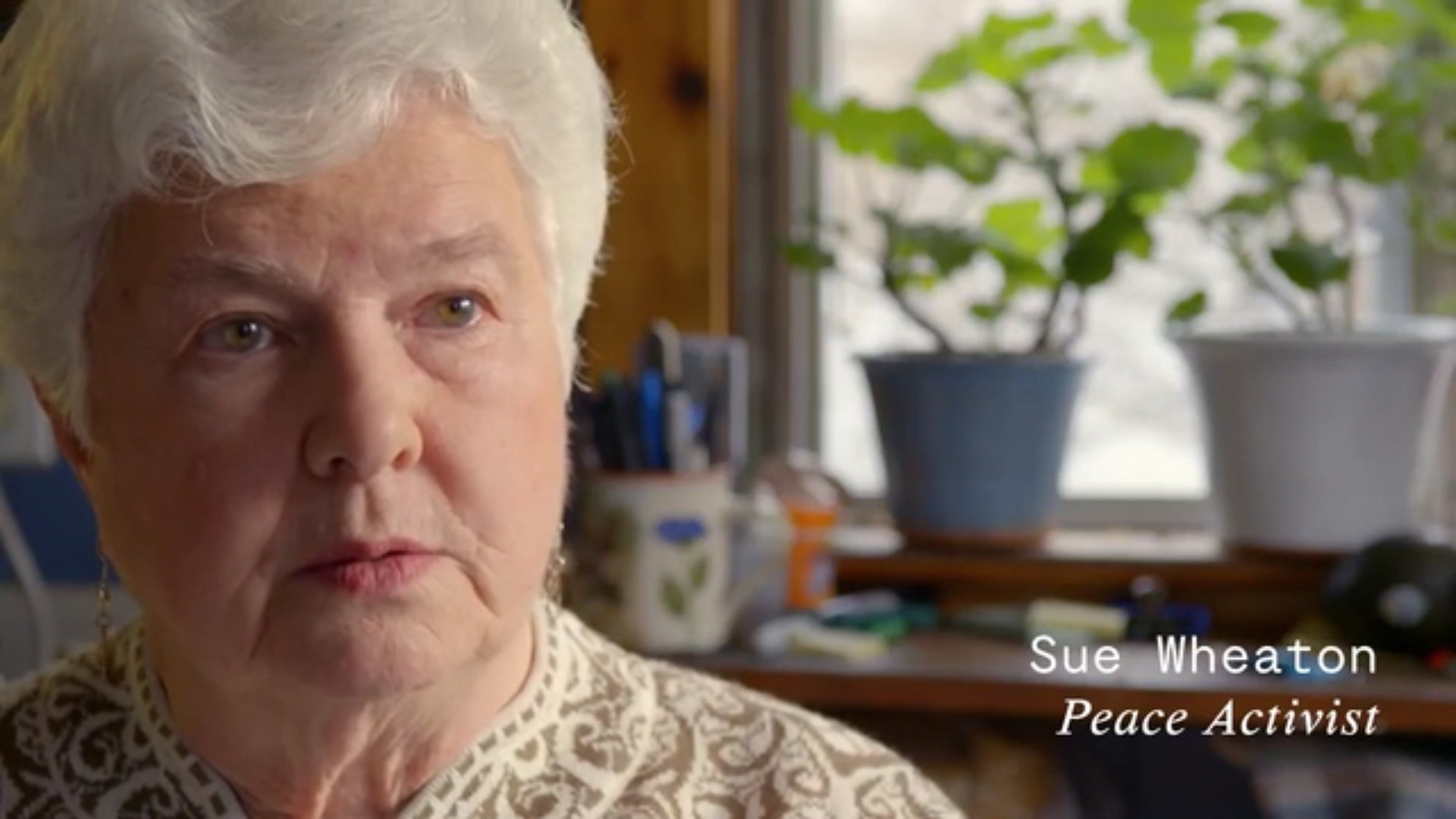
Max Good's main propagandist, James DiEugenio, "peace activist" Sue Wheaton and an anonymous source outline their suspicions:

DiEugenio: "Later on in her life Ruth Paine goes down to Nicaragua, and there were reports of her going to Sandinista sympathizer meetings and taking notations of what went down. For many, many people, the veneer has come off Ruth and Michael Paine, and they are just not credible any more."

Anonymous man (image scrambled and voice altered): "I know a woman who in the early 1990s who worked with Ruth Paine as a Christian peace activist in Nicaragua. This was during the time of the civil war in Nicaragua during the Reagan and Bush I years."

Sue Wheaton: "It was a contentious time down there. It was very clear that the CIA was supporting the so-called Contra freedom fighters all the way. The Contras were the ones opposing the Sandinista revolution."

Anonymous man: "The Christian group that this woman and Ruth were involved with was called ProNica. And they were helping the poor people of Nicaragua who naturally sided with the Sandinistas. And because of this, these Christian peace groups were often heavily monitored by our U.S. intelligence agencies."

Ruth Paine: "My work in Nicaragua was with a Quaker organization. We had a project to help the poorest of the poor in Nicaragua. And at one of these meetings a woman showed up and proceeded to accuse me of a lot of things."

Wheaton: "She introduced herself as Ruth Paine, representing the Quakers. And I said, well, you're not the Quaker Ruth Paine who knew Marina Oswald are you?"

Anonymous man: "This woman told me that after Sue Wheaton had told people about Ruth's association with the assassination, which they did not know about, then they became even more suspicious of her. She and others in their organization believed that Ruth was a CIA agent or asset who was down there for the purpose of gathering information about the group."

Wheaton: "So Ruth had a photographer that came and was with her. He was there snapping everybody. And that’s when they said, well, we’re doing this article for the Nicaragua Network. But Nicaragua Network had never heard of such a story. They were taking everybody's picture at a meeting, and we tried to take their picture and they left."

Thus, if Good, DiEugenio and Wheaton are to be believed, Ruth Paine first assisted the CIA with their murder of Kennedy. After proving herself in this assassination mission, Paine was apparently not content with simply fading into obscurity and agreed to travel to Nicaragua to do the agency's bidding supporting the Contras. Researcher Greg Doudna looked into the claims made in the film and this article is based on his work.

First, it is necessary to have an understanding of who Wheaton is. She is no doubt a peace activist and a fine woman, but she is also a JFK conspiracy believer and possesses all the inherent biases as a result. Wheaton wrote a paper that she called "Occurrence in Nicaragua" in 1991 to document her interaction with Ruth Paine. The article also outlines her beliefs regarding the JFK killing.

Wheaton wrote that the House Select Committee on Assassinations (HSCA) "closed its doors after several of its witnesses were killed and/or died under mysterious circumstances." Wheaton also claims that "many" researchers concluded that the JFK murder was "a conspiracy involving the CIA, organized crime, anti-Castro Cubans, and right-wing activists and businessmen, with prior knowledge and cover-up by the FBI and members of the Dallas police force."

These researchers (whom Wheaton obviously agrees with) also believed that "Oswald had intelligence connections" and while he "probably was involved in the conspiracy in some way," he "did not fire the shots which killed Kennedy (which these researchers conclude came from the front) and possibly did not even fire a gun during the assassination." Needless to say, these beliefs go against the findings of both the Warren Commission and the HSCA whose investigations concluded that Oswald fired the shots that killed JFK and had no connection to US Intelligence.

Most damaging to her credibility is the fact that Wheaton was a follower of New Orleans District Attorney Jim Garrison. Books have been written about Garrison's unwarranted and destructive prosecution of Clay Shaw, most recently by Fred Litwin who demolished Garrison and acolytes such as DiEugenio and Wheaton by association. Perhaps tellingly, Wheaton concludes her litany of conspiracy beliefs with several that found their way to Max Good's film (p. 2 of the PDF).

It is through the lens of her conspiracy beliefs that Wheaton's claims regarding Ruth Paine must be viewed. On February 5th, 1991, according to Wheaton's account and details provided by Doudna, Ruth attended a council meeting of the Benjamin Linder House in Managua with Jon Roise who was the newly appointed director of the (Quaker affiliated) Friends Center and a member of the council. Ruth was then the director of the St. Petersburg, Florida-based ProNica organization which Roise oversaw along with all Friends activity in Nicaragua. Wheaton was at the meeting representing "another" Benjamin Linder House member group which, according to one report, was "anti-Contra."

Things started innocently enough. After Ruth introduced herself to the group, Wheaton asked if "she were the same Quaker Ruth Paine who had known the Oswalds." Ruth said that she was and after Wheaton said she was interested in the assassination, Ruth sensibly suggested that she read Marina and Lee (which Wheaton obviously never did since she referred to the book in her document as "Lee and Marina").

Wheaton admits that Ruth was "well informed" and took "many notes on everything we discussed." Wheaton writes that Ruth "made comments which indicated she shared the presuppositions and objectives of others in the group, and she was fully involved in the discussion." Wheaton found Ruth's level of involvement "unusual" since visitors normally do not attend council meetings. But as director of ProNica, Ruth was no mere visitor. Among other statements made by Ruth that Wheaton found to be not "in sync" with Wheaton's own opinion was her dubious reaction to one estimate that "hundreds of thousands" of civilians had been killed by US bombing in Iraq.

The next time that Ruth and Wheaton came together was at a "pot luck" at the Benjamin Linder House on February 15th. By Wheaton's own account, Ruth was unaware that the group was planning to discuss "the implications of the Kennedy assassination related to the course of U.S. politics and foreign relations." According to Wheaton, this had been "tentatively" planned two months prior. One has to wonder if the "tentative" plan was quickly finalized after the appearance of Ruth at the previous meeting. In any case, despite being surprised by the topic of conversation, Ruth graciously shared her observations on the Oswalds and the assassination when asked to do so. Although her remarks consisted of the well-known story she has told repeatedly over the years, what was likely most significant to the conspiracy-oriented Wheaton was Ruth's admission that she believed the Warren Commission conclusions.

"During the next two or three weeks," Wheaton reports, Ruth, Roise and a young man named Sean Miller attended meetings at the Linder House and other locations. Miller, according to Wheaton, "took many pictures, using a special lens, and taped presentations." Ruth allegedly said that Miller was staying at the Friends Center and taking pictures for the Nicaragua Network.

According to Wheaton, "Ruth came to the March meeting" of the Benjamin Linder Council and "took copious notes of every name, organization and subject mentioned." She also "peered over the organizational membership list in the office prior to the meeting and took notes." Wheaton says that at the close of the meeting, the chairperson asked if Ruth would provide "a copy of her report." Ruth responded that "her notes were simply for her report to the group back in St. Petersburg and the purpose was to determine whether or not the Quaker project would continue as a member group of the Ben Linder Council." Ruth added that she planned to recommend that they continue as a member since she believed that their work was "of value." She added that Miller was "not affiliated with her program."

It would seem that the original problems with Ruth in Nicaragua, as documented by Wheaton in April of 1991 shortly after the events took place, were that she took copious notes and a young friend of hers was taking photographs. At some point, it is clear that rumors began to spread that Ruth and Miller's activity was undertaken at the behest of the CIA. Two additional allegations came to light in January of the following year when Wheaton claimed that "The Nicaragua Network in Washington, D.C. told a friend of ours that they had not commissioned anyone to take pictures in Nicaragua." Wheaton concluded that Ruth's explanation for the photographs was "not valid."

The second allegation was that the "Quakers" were assisting Contra-affiliated individuals with "support." Evidently, this report came from Wheaton's husband. The implication is that the Contras were known to be backed by the US government covertly during the Reagan administration so Ruth and the Quaker-affiliated groups must be working for the government as well.

But as it turns out, in an April 1991 meeting with Wheaton and her husband Jon Roise provided some answers to their concerns. The meeting also made it clear who was driving the insinuations against Ruth. After Roise expressed his concern that a "whisper campaign" against Ruth was underway, Wheaton assured him that was not the case because rather than whispering she had "been telling people loud and clear" about Ruth's "history" with the assassination. Wheaton went on to say that she "had no intention of not talking about [Ruth's role in the assassination story]."

Roise explained to Wheaton that it was Ruth's habit to "write things down." Indeed, Greg Doudna, who met Ruth at the St. Petersburg Friends Meeting in the early 2000s, has noted that the Friends are known to document virtually everything and historians consider their records to be among the best in existence.

To sum up the situation as it existed circa 1991-92, we have the following allegations/concerns against Ruth and Miller which were admittedly strenuously promoted by Wheaton herself among what she calls the "U.S. solidarity community":

  • Ruth took "copious" notes.
  • Miller took photographs and recorded presentations.
  • Ruth's explanation that Miller was taking photos for the Nicaragua Network was not accurate.
  • Ruth's organization provided "support" for Contra-affiliated individuals.

Note that there could have been concerns about Ruth that predated Wheaton although these are undocumented and seem to come from second-hand reports. And while there is no indisputable evidence that Wheaton told anyone that Ruth was working for the CIA, the circumstancial evidence convinces some Ruth supporters. Thomas Mallon, author of Mrs. Paine's Garage, writes "Wheaton managed to convince three or four people Ruth worked with that Mrs. Paine was not to be trusted; they came to wonder whether Ruth’s presence in Nicaragua wasn’t really a matter of undercover intelligence activity." "I tend to take photographs and try to remember names," Ruth told Mallon, “and that made them extremely nervous.”

But there is a reasonable explanation for each of these concerns that does not require either Ruth or Miller to be CIA assets. First, as Roise and Doudna point out, it is normal for individuals working for the Friends to take notes. Additionally, as Wheaton knew, Ruth was in the process of determining whether ProNica would continue to be associated with the Linder House. Anyone in this position could be expected to be taking notes and doing ordinary fact-finding.

On the issue of the photography, Wheaton implies in the Good film that Miller was working with Ruth and Roise. But, as her article makes clear, Wheaton was told that Miller was a student who was "simply a guest at the Quaker hospitality house and his pictures were for the Nicaragua Network, not her organization."

Wheaton says that the Nicaragua Network told "a friend" that Miller had not been commissioned to take photos. What friend? Who was this second-hand source and how is anyone to judge the accuracy of this alleged report? But for the sake of argument, let's say the report is correct and Miller was not working for the Nicaragua Network but was taking photos for some undetermined reason. Miller could have told Ruth that he was taking pictures for the Nicaragua Network and Ruth, with no reason to doubt Miller's word, simply repeated this to Wheaton and the rest of the group.

As for Wheaton's concern that the Friends were helping Contra-affiliated people, it should be mentioned that one of the individuals in question was a former Contra fighter who was in a wheelchair and living in a squatter settlement. According to Doudna it is "in keeping with Friends practice" to provide what was certainly humanitarian assistance to such individuals.

Of course, the notion that the CIA would send people to meetings in Nicaragua to take photographs and collect information in a completely overt manner is extremely dubious at best. And if Ruth and Miller were really CIA assets, wouldn't they have had an indisputable cover story? If this were the end of the saga, it would be bad enough. But the allegations given life by Wheaton have endured and been expanded by her and others.

New accusations against Ruth emerged in a 1996 report by Steve Jones, Carol Hewett and Barbara LaMonica. The person fueling the accusations against Ruth was again Wheaton who now maintained that Ruth was not simply making notes but specifically, "taking down information about Americans in Nicaragua who opposed U.S. policy there." Additionally, Wheaton reported that "someone" had informed her that Ruth was "copying everything" on the bulletin board. Ruth also allegedly made reference to people in the US embassy whom Wheaton "abhorred."

Jones returned with "new evidence" circa 1997 resulting from his conversations with yet another unidentified individual. This person was ostensibly a "close personal friend" of Ruth's although one wonders what type of "friend" reveals such uncomplimentary information. This "friend" went on to reiterate the same accusations voiced by Wheaton with some new additions. New were "inappropriate personal questions" that Ruth had supposedly asked. Most remarkably, in the latest story it was not Miller but Ruth who was taking photographs.

In a speech to the Coalition on Political Assassinations in 1998, Vincent Salandria stated "According to recent research in the 1980s Ruth Paine assisted illegal anti-socialist activity in Nicaragua." According to Doudna, this statement was based entirely on the humanitarian aid provided to the ex-Contra fighter and others like him.

This brings us to 2022 and the statements of Wheaton in Good's film. Now rather than just taking photos, Miller was "snapping everybody." Wheaton also uses the word "they" which implies that Ruth and Miller were working together, a fact that she knows is not true. Additionally, she adds the new detail that Ruth and Miller "left" after her group tried to take their photo.

What was the true nature of Ruth's work in Nicaragua? The ProNica website reports:

"In 1996 Ruth Paine, a member of St. Petersburg Meeting wrote, “We began ten years ago, a volunteer crew of defenders of human rights. We wanted to do something tangible. We now have a very effective organization with a clear mission delivering aid to very well-run projects in Nicaragua.”

"On May 31, 2002, ProNica, Inc. became a Florida non-profit corporation, focusing on healing and peace building. Ruth stepped up to reorganize ProNica. Ruth Paine directed ProNica for many years, working steadily building the organization and its reputation for integrity and true solidarity. Ruth never collected a salary."

"ProNica sponsored AVP (Alternatives to Violence Project) workshops in Nicaraguan prisons in the 1990s and eventually spread across the country by training ‘trainers’ using the AVP model to teach non-violence and self-empowerment. Money was raised to drill wells in communities to provide safe potable water sources. Cooperative groups of women were given funding to jointly raise poultry to earn money and feed their families. ProNica helped develop a cooperative’s transition to the production of organic sesame oil, which garnered a fair trade contract with The Body Shop. The ProNica newsletter told stories of Nicaraguan communities organizing collective responses to their post-war needs for trauma healing, feeding and housing displaced people, establishing free clinics for women for cancer screening, pre and post natal care, family planning, and counseling for the high rates of abuse and post-traumatic stress."

Summing up this sorry chapter in JFK assassination lore promoted by Max Good and his cohorts, there is absolutely no credible evidence that Ruth Paine was doing anything other than charity work when she ran into Sue Wheaton in the early nineties. The Wheaton story has been exaggerated over the years beyond the facts in her original report. The accusations are based on gossip and innuendo and the suspicions of those like Sue Wheaton who are predisposed to dislike Ruth because of their conspiracy-oriented beliefs and because Ruth's group was willing to provide humanitarian support to the Contras that Wheaton opposed.

Monday, June 27, 2022

The Assassination and Mrs. Paine-JFK and Vietnam

What was the motive of the conspirators whose yet undetected plot killed President John F. Kennedy? Filmmaker Max Good allows two of his "featured" conspiracy mavens, James DiEugenio and Gary Aguilar, to lay out the case that JFK was planning to pull out of Vietnam as part of a larger effort to spread peace throughout the world:

Aguilar: (41:45) "Kennedy was telling people privately that once he got re-elected, he was going to back out of Vietnam and he was not going to commit forces of the United States to a land war in Asia. He had infuriated them [the conspirators presumably the CIA and the Joint Chiefs] with the Bay of Pigs. He infuriated them with the Nuclear Test Ban Treaty. He infuriated them during the Cuban Missile Crisis. And he was not gonna let them have their war. [claps and then makes umpire’s over-the-shoulder 'you're out' sign] ‘Next’ (chuckles). Very, very few people were ever allowed the intimate details [of the alleged plot], I'm sure. Kennedy was taken out, and [mimicking voice of lone assassin advocates] anyone who doubts the official statements of [the] US government is crazy!"

DiEugenio: (1:34:30) "One of the things that you study if you try and take in the big picture is what happened to American foreign policy after [JFK's death]. When Kennedy was assassinated there was not one American combat troop in Vietnam. By 1967, there were over half a million there. American foreign policy becomes much more militant, much more violent in the third world."

But the argument that JFK was a peacenik in the making is not supported by a preponderance of hard evidence. Even in his foreign policy decisions apart from Vietnam, Kennedy looked every bit the typical cold warrior. For instance, in 1961 during the Berlin crisis JFK seriously contemplated a nuclear first-strike against the Soviet Union in response to agressive actions taken by Nikita Khrushchev toward the German capital. And although he altered President Eisenhower's original plan, JFK ordered the Bay of Pigs invasion in an attempt to eliminate communist leader Fidel Castro. After the failure of that mission, Attorney General Robert Kennedy oversaw an organized assassination operation against the bearded leader.

On the question of Vietnam, Kennedy had signaled his attitude even before assuming office. As a US Senator in 1956, he refered to the southeast Asian nation as “the cornerstone of the free world in Asia” and added that it was “our offspring, we cannot abandon it.” JFK set the tone for his foreign policy in his inaugural address when he said, "Let every nation know, whether it wishes us well or ill, that we will pay any price, bear any burden, meet any hardship, support any friend, oppose any foe, to assure the survival and the success of liberty."

After assuming the Presidency, JFK began to see the political expediency that a successful action in Vietnam could provide. In addition to the obvious goal of halting the spread of communism in Southeast Asia, JFK advisor Walt Rostow suggested that “clean-cut success in Vietnam” would be one way to divert attention from the Bay of Pigs debacle. Indeed, General Lionel McGarr, head of the American Military Assistance Advisory Group in Saigon, noted that there was a "strong determination" to stop the “deterioration of US prestige” early in the JFK administration.

By January of 1962, Kennedy authorized the Counterinsurgency Plan for southern Vietnam which called for training the South Vietnamese forces in both conventional warfare and anti-guerrilla tactics. JFK ultimately approved the expansion of the Army of the Republic of Vietnam (ARVN) to 219,000 troops and the Civil Guard to 77,000. To pay for the escalation, South Vietnamese President Ngo Dinh Diem received an additional $42 million from Kennedy on top of the $225 million he was already getting. Furthermore, the number of American advisors in Vietnam grew from just 800 when JFK took office to 16,700 at the time of his death. It is clear that despite what DiEugenio and Aguilar maintain, the United States under Kennedy had made a substantial military commitment to South Vietnam.

Two key September 1963 interviews with Chet Huntley and Walter Cronkite confirmed JFK's dedication to the Vietnam cause. Kennedy told Cronkite, "... I don't agree with those who say we should withdraw. That would be a great mistake. I know people don't like Americans to be engaged in this kind of an effort. Forty-seven Americans have been killed in combat with the enemy, but this is a very important struggle even though it is far away." Similarly, JFK told Huntley, “withdrawal only makes it easy for the Communist. I think we should stay.”

Further evidence of JFK's commitment to Vietnam is provided by his tacit approval of the coup against President Diem just three weeks before his own death. Kennedy had decided, as diplomatic and military officials in southern Vietnam had reported, “that the war against the Viet Cong in Vietnam cannot be won under the Diem regime.” While JFK was shocked when Diem and his brother were murdered, there can be no doubt that he sanctioned the coup that removed them from power because of Diem's ineptitude in fighting the communists.

National Security Action Memorandum (NSAM) 263 is often cited by theorists as proof that JFK planned to withdraw from Vietnam by the end of 1965. But the order does no such thing. JFK signed NSAM 263 in October of 1963 and while the directive did call for the withdrawal of 1000 military personel, it is neccessary to look at the big picture. Robert Thompson of the British Advisory Mission refered to the withdrawl as a "token" one in a 1962 meeting with JCS Chief Maxwell Taylor. In a confab with JFK the following year, Thompson used similar language and there is no indication that Kennedy or his top advisors differed with this assessment. This limited withdrawal was designed to reap political benefits at home while not adversely impacting the war effort and definitely "was not part of a Kennedy plan to pull out of Vietnam" as historian Mark White notes. The withdrawal also served as a device to apply pressure on Diem (before a final decision on his fate had been reached) but remained firmly contingent on the military success of the ARVN forces.

The language used by Kennedy in an October 31st press conference reinforces the concept that troop withdrawl was dependent on military success. JFK stated in response to a question about troop reductions (emphasis added) "If we are able to do that, that would be our schedule. I think the first unit or first contingent would be 250 men who are not involved in what might be called front-line operations. It would be our hope to lessen the number of Americans there by 1000, as the training intensifies, and is carried on in South Vietnam."

Moreover, NSAM 263 outlined the continuation of the same US policies that were previously in effect. Those included the Vietnamese taking over “essential functions” of warfare by late 1965. Indeed the “central object” of the US presence in Vietnam continued to be “to assist the people and Government of that country to win their contest against the externally directed and supported Communist conspiracy. The test of all decisions and U.S. actions in this area should be the effectiveness of their contributions to this purpose.”

Perhaps the most compelling proof of JFK's anti-communist agenda and his commitment to Vietnam comes from the text of his undelivered speech prepeared for the Dallas Trade Mart luncheon. On the day of his death, JFK would have reminded the attendees of his foreign policy successes in Berlin and Cuba. He also planned to provide an extensive laundry list of increases in both conventional and nuclear weapons under his watch. Significantly, JFK would have reminded the audience of the aid that the US was giving other countries to fight the Communist menace. Finally, Kennedy would have firmly told the assembled guests, “Our assistance to these nations can be painful, risky and costly, as is true in Southeast Asia today. But we dare not weary of the task.”

Comments by members of JFK's inner circle provide more evidence that he had no plans to pull out of Vietnam. Kennedy's Secretary of State, Dean Rusk, vehemently disagreed with the notion that he had decided to abandon the cause. "I talked with John Kennedy on hundreds of occasions about Southeast Asia," Rusk wrote in his memiors, "and not once did he suggest or even hint at a withdrawal."

Similarly, Robert Kennedy gave interviewer John Bartlow Martin a firm "no" when asked if there was "any consideration given to pulling out [of Vietnam]." "The president felt," Bobby continued, "... He had a strong, overwhelming reason for being in Vietnam and that we should win the war in Vietnam."

Critical to the conspiracy notion that JFK was murdered by unnamed military figures is the concept that these actors strongly desired a full-scale war in Vietnam. But there is solid evidence that not all of JFK's military people were the "hawks" they are made out to be by the likes of DiEugenio and Aguilar.

For example, Army Chief of Staff General George Decker believed “there was no good place to fight” in Southeast Asia. The commander of U.S. forces in the Pacific, Admiral Harry D. Felt, stated he was “strongly opposed” to troop deployments. One reason for Felt's reticence was his belief that the ARVN would be less effective if American troops did the brunt of the fighting. Felt was convinced that the US role should be limited to training and supplying arms to the ARVN.

Among the war's harshest critics was Colonel John Paul Vann. His leaks to the New York Times revealed that South Vietnamese forces were refusing to fight while huge numbers of civilian villagers were becoming casualties of American weaponry. Indeed, an Army report from 1962 noted, “the military and political situation in South Vietnam can be aptly described by four words, ‘it is a mess.’”

A final indication of the invalidity of the DiEugenio-Aguilar Vietnam theory is the post-assassination behavior of the military men who susposedly authored the first American coup against a sitting president. If these individuals really wanted to remove JFK to facilitate an all-out war against communist forces in Vietnam, why did they balk at Johnson's 1964-65 escalations of the conflict? Both Taylor and William Westmoreland, known for their hawkish reputations, expressed strong opposition to combat troops during this period as did other ranking officers. Many of JFK's military men recognized the inherent problems with fighting a war in Vietnam and prefered to avoid conflict there.

In conclusion, the sophomoric view that JFK had decided to get out of Vietnam and that choice led to his death at the hands of conveniently unnamed conspirators is poorly supported by the evidence. In his book, Destiny Betrayed, DiEugenio went even further than his on-camera statements to Max Good. On page 65, he wrote that JFK was "formulating his policy to withdraw from Vietnam" and "disguising" (p. 371) that plan around his reelection. While DiEugenio may believe that he knows that JFK would have pulled out of Vietnam had he lived, real historians remain divided on the issue. But those experts all agree on one thing—it is impossible to know for sure.

Special thanks to Fred Litwin for providing sources for this article.

Wednesday, June 22, 2022

The Assassination and Mrs. Paine-Back and to the Left?

Another conspiracy golden oldie that filmmaker Max Good is happy to give time to is the interpretation of the “back and to the left” motion of JFK seen after frame 313 of the Zapruder film (10:20). “Finally in the mid-seventies the Zapruder film was shown to the public,” says Gary Aguilar a California-based physician who is a vocal critic of the lone assassin theory. “It shows Kennedy going back and to the left and everybody goes ‘hey wait a minute, if he’s shot from behind why is he going back to the left?’” Aguilar continues, “So then the House Select Committee looked at it again and they concluded that it’s likely there was a conspiracy.” Dutifully, Good zooms in on a page from the HSCA report that indeed states, “President John F. Kennedy was probably assassinated as a result of a conspiracy.”

But the infamous “back and to the left” motion occurs only after a nearly imperceptible (at normal speed viewing) approximately 2.3 inch movement of JFK’s head forward between frame 312 and frame 313. This motion was first recognized in the sixties and as researcher Nicholas Nalli explains, “the only plausible source for this instantaneous, isolated forcing mechanism is manifestly and unequivocally the projectile impact [of a bullet fired from behind the President].”

Nalli notes that Nobel-prize winning physicist Luis W. Alvarez wrote about the so-called "jet-effect," a recoil caused by tissue matter exiting the large wound at the right-top of JFK's head, back in 1976 as an explanation for the back-left movement of the President. Nalli, who has written a scholarly paper on the subject, postulates that the motion that theorists believe indicates a frontal shot is caused by a combination of Alvarez's jet-effect and a neuromuscular reaction.

Theorists such as Aguilar believe that an extremely high velocity weapon firing a bullet from the front could create the movement seen on the Zapruder film. But Nalli's paper debunks two of the more popular frontal shot theories—frangible bullets and a near simultaneous head shot. Other factors working against a frontal shot include the beveling of the large wound in JFK’s head as seen at autopsy which showed that it was an exit rather than an entrance wound. In Internet discussions, Aguilar tries to counter this by saying that there are "exceptions" that prove beveling is not foolproof. But more than a dozen forensic experts have examined the autopsy photographs and x-rays over the years. They agree that the wound in the back of JFK's head is one of entrance and the large wound on the right side of the head observed both in the autopsy photos and the Zapruder film is the exit.

The forward motion of most of the matter expelled from JFK's head coupled with the skull fragments found to the left front of the limousine also support a shot from the rear. Additionally, no credible physical evidence of a grassy knoll or other front-firing gunman was found while the evidence for a rear shot from the Depository Building fired by Oswald is compelling.

By the way, had Good not quickly whited out most of that page from the HSCA report mentioning conspiracy, viewers could have learned that the HSCA also determined that “Oswald’s other actions tend to support the conclusion that he assassinated President Kennedy.” Further study would reveal that the sole basis for the HSCA conclusion of conspiracy was the so-called acoustics evidence rather than the "back and to the left" motion on the Zapruder film as Aguilar implies (or at least as Good's editing of Aguilar's comments implies).

A complete discussion of the problems with the acoustics evidence is well beyond the scope of this article. But the following excerpt from my previous blog article summarizes a few of these:

For those unfamiliar with the subject, two teams of acoustics experts analyzed data originating from a recording of Dallas police communications during the Presidential motorcade on the day JFK was killed. One team found that a 95% probability existed that a shot had been fired from the “grassy knoll.” This led to the unfortunate conclusion of “probable conspiracy” by the HSCA. Nalli [in his article The Ghost of the Grassy Knoll Gunman] argues that there are three “general categories of arguments” that discredit the acoustics evidence:
  • Timing issues.
  • Open mic location assumptions.
  • Insufficient information-content within the DPD recordings.

Nalli’s summary of just the mic location issues alone is enough to discredit the acoustics evidence:

the location of the transmitting mic was not found to be in the specific place it needed to be (as established by [Dale] Myers), nor in the motorcade (as established by Sonalysts), nor did the suspect impulses occur during the assassination timeframe (as established by Ramsey, Linsker, et al.), and the match was not to the exclusion of all other locations (as established by [Michael] O’Dell). These subsequent facts confirm to us that the Dictabelt waveform patterns (including those attributed to “echoes”) had a non-gunshot source.

Interested readers should take the time to read Nalli’s demolition of the acoustics evidence which draws on the work of several researchers.

In conclusion, the "back and to the left" motion of JFK as seen on the Zapruder film is explainable by a combination of a "jet effect" and a neuromuscular reaction. Additionally, the preponderence of the evidence supports the conclusion that a shot from the rear of the motorcade caused JFK's fatal head wound and does not support a grassy knoll or other front-firing gunman. The HSCA, while confirming that Oswald killed JFK, based their claim of probable conspiracy on the since-debunked acoustics evidence. Max Good does not tell his viewers any of these facts.

Monday, June 20, 2022

The Assassination and Mrs. Paine-LN Experts Diminished?

Filmmaker Max Good tells Ruth Paine (1:23.00) that he has "tried to be objective" and "take in all different viewpoints" and not be "too biased." Paine responds skeptically, "Oh really?"

Mrs. Paine's skepticism is well founded. When analyzing the film, I found an imbalance between the individuals representing the conspiracy side of the debate and those arguing the lone assassin point of view in several respects. Let's meet the film's major players (listed in the credits under "Featuring"):

Conspiracy

  • Jim DiEugenio-author and researcher
  • Dr. Gary Aguilar-researcher
  • Bill Simpich-author and researcher
  • Vincent Salandria-author and researcher
  • Peter Dale Scott-author and researcher
  • David Lifton-author and researcher
  • Dr. E. Martin Schotz-author and researcher
  • Sue Wheaton-(identified as a "peace activist" but she is also a conspiracy believer with a severe bias against Ruth Paine)

Lone Assassin

  • Ruth Paine-Warren Commission witness
  • Priscilla Johnson McMillan-author
  • Max Holland-author and researcher
  • Michael Paine-Warren Commission witness
  • Gerald Posner-author
  • Joe Alesi-researcher

What is immediately apparent is an 8 to 6 numeric imbalance in favor of the conspiracy side. But that is counting Michael Paine who appears in the film infrequently. Similarly, Joe Alesi appears in one segment only (Cuban Sympathizers). That means that four individuals (Ruth Paine herself, McMillan, Holland and Posner) are left to counter the onslaught of accusations by the conspiracy people. For his part, Michael Paine is interviewed by Good but only briefly. After Michael talks about Oswald's guilt, Good tells the audience that he has become increasingly "incoherent." Ultimately, Salandria tells viewers (without proof) that Michael is "an agent" of some unidentified group.

Posner is introduced by Good as follows: "Since the release of his 1993 best seller, Case Closed, author and attorney Gerald Posner has been the go-to expert representing the official story." Posner then gets 32 seconds to make his case for the Paines.

Compare that to the treatment accorded Salandria: "On the other hand you have a 92-year-old Philadelphia lawyer, Vince Salandria, a legend among conspiracy researchers. In 1964 he was among the first to publicly challenge the conclusions of the Warren Commission. For over fifty years his analysis of the case has been considered to be the most cutting edge, or the most extreme, depending on your persuasion." Salandria then has nearly a minute and a half to expound on the Paine's guilt.

But despite being labeled the "go-to expert" for the lone assassin theory, Posner is used in the film sparingly and his footage is sometimes utilized to make him appear to be arguing a point favorable to conspiracy believers. For instance, at 1:06:23 Posner says "Who gets two telephone calls on Sunday two days after the assassination from Lee Oswald in Prison? Ruth Paine." Later Posner adds "Those calls would have been a footnote to the entire story. They became important only because they were the last telephone calls that Lee Oswald made to anyone in the world and they were to Ruth Paine and the only person who can say what Oswald said is Ruth." This footage of Posner is used by Good to imply that Ruth has once again suspiciously appeared in the life of Oswald to influence his fate. Because of this purposeful diminishment of Posner, who could have quickly dispatched any and all conspiracy notions, Paine herself, Holland and McMillan are left to argue the bulk of the lone assassin cause and defend Mrs. Paine and her former husband.

While DiEugenio and his comrades argue for every conspiracy theory imaginable (some of which have been debunked years ago and are not supported by the documents displayed in the film) the trio of LN advocates soldiers on quite effectively. Then, at about 1:27:00, something fascinating happens. Ruth tells Good (1:26:48) "Max Holland has been a researcher especially looking at what the Warren Commission did and what they didn’t do. What they knew and what they didn’t know. That’s good research." Good immediately turns his attention to Holland.

Holland tells Good that he attended the same college (Antioch in Ohio) that Ruth Paine did. Holland also says that he worked for the Quakers (Ruth's religious affiliation) for two years. Soon after, Holland says the following while the film shows him retrieving a gun from a case:

A favorite tactic of conspiracy theorists is to make accusations that anybody who they disagree with has a connection with the intelligence community. Its been made against me, its been made against Ruth and Michael. The only explanation could be that we’re part of the coverup, paid by the CIA or [shrugs]. For better or worse I did write one article for a CIA published journal. So people have turned that into the fact that I work for the CIA. I was aware they gave monetary awards for best article of the year. That’s how I earn my living, is getting paid for my writing. So, accepted the award of course because it was a thousand dollars.

Earlier in the film, Good admits that "There are all kinds of claims and rumors about the Paines but no concrete evidence has ever directly linked them to the CIA." But incredibly, despite this knowledge, and Holland's explanation regarding the conspiracy playbook —anyone who disagrees with them must be accused of working for the CIA—Good, without any apparent self-awareness, busies himself doing exactly that. First, he implies that Holland, who attended the same college as Ruth and worked for the Quakers, will write whatever the CIA wants if they pay him enough.

Next, after Ruth gives a glowing description of McMillan and her seminal book Marina and Lee, Good turns his attention to the nonagenarian accusing her of being a "witting collaborator" for the CIA, a fact that she always denied.

Indeed, McMillan told Robbyn Swan in 1994, “My bottom line is that I never worked for the CIA… . I don’t know what was in the mind of the person who put me down as a Witting Collaborator … [In Moscow] I had no way of knowing who in the American Embassy, say, worked for the CIA and who didn’t.”

Note that the "witting collaborator" designation may be solely based on McMillan's reportage to the Domestic Contacts Division. McMillan cooperated with the agency in this respect along with thousands of other individuals. But she never considered herself a "witting collborator" in the manner that is implied by the film.

In a similar vein, Good presents a document that states "I think that Miss Johnson can be encouraged to write pretty much the articles that we [the CIA] want." But Good does not explain in what context the remark was made. McMillan was interviewed in 1962 by Donald Jameson of the CIA's Soviet Division. The sole purpose of the interview was to judge whether McMillan could be asked to write an article on poet Yevgeny Yevtushenko that was amenable to the agency.

Good further neglects to tell his viewers Jameson also stated that "It would be important to avoid making her think that she was being used as a propaganda tool and expected to write what she is told. I don't think she would go along with that idea at all"(emphasis added). This is probably why Jameson never even raised "the issue of her writing an article at our inspiration." The fact is, there is no evidence that McMillan ever wrote anything at the behest of the agency.

Some of the exchange Good has with McMillan occurs while a photo of Ruth and Michael Paine is displayed on McMillan's refrigerator. The implication is obvious.

To sum up, Max Good outright accuses or at least implies that three of the "featured" defenders of Paine and the lone assassin theory in his film, Paine herself, Holland and McMillan, are CIA employees or assets. I submit that this treatment would severely diminish (or totally cancel) the effectiveness of their assertions regarding Ruth and the lone assassin theory to an uninitiated viewer. On the other hand, while Good's film purports to be "objective," the conspiracy experts are allowed to present any theory they want (even those that are dubious at best or demonstrably false) with little or no pushback.

Friday, June 17, 2022

The Assassination and Mrs. Paine-The Coffee Klatch

Note from Webmaster: The caption in the above image of David Lifton is Max Good's original creation and is incorrect. David Lifton is not an attorney.

Author David Lifton explains one of the more popular conspiracy theories regarding Ruth Paine (51:10):

She [Ruth] makes the phone call on Monday [Oct 14, 1963]. Then he [Oswald] goes in for the interview on Tuesday, and he starts work on Wednesday. The people involved in this plot have done site selection in advance. They’re planning to murder President Kennedy on this trip. Oswald is going to get a job at that building. That’s the setup.

But this theory is impossible unless one believes that numerous individuals besides Ruth were involved. One would also have to believe that the conspiracy somehow knew the route of the motorcade even though it had not yet been proposed. Similarly, the conspirators could not have known the day of the week that the motorcade would occur, leaving open the possibility that it could have been scheduled for a weekend when Oswald would not be working at the Texas School Book Depository (TSBD).

It all started when four ladies, Ruth Paine, Linnie Mae Randle, Dorothy Roberts and Marina Oswald met for coffee at the Roberts' home. During the conversation, the subject of Lee Oswald's lack of employment while his wife was expecting a baby came up. The group mentioned several places where Oswald might look for a job including Manor Bakeries, Texas Gypsum and the TSBD. Mrs. Randle noted that her brother Wesley had recently aquired a job at the TSBD.

After returning to the Paine home (Marina was living with Ruth at the time) Marina asked Ruth if she would phone the TSBD and find out if they were hiring. Ruth called and spoke to Roy Truly, the building superintendent, who told Ruth that Oswald should apply in person. He did so and was hired on October 15th.

But if Ruth Paine was working for the CIA, who would her accomplices neccessarily include? Certainly Linnie Mae Randle who brought up the notion of the TSBD and her brother previously obtaining work there. Roy Truly would also have to be in on the conspiracy since the depository operation consisted of two locations and he could have sent Oswald to the other location at 1917 Houston Street which was not on the motorcade route or neglected to hire him at all.

Additionally, those individuals tasked with hiring employees at four companies where Oswald unsuccessfully applied during his job search would have had to be cogs in any conspiracy. Note that none of these companies were on the motorcade route and Oswald aquiring a job at any of them would have scuttled the assassination. They were: Padgett Printing (Oct. 4th), Solid State Electronics Company of Texas (Oct. 8th), the Burton-Dixie Corporation (Oct. 9th) and the Wiener Lumber Company (Oct. 14th).

Additionally, the Texas Employment Commission tried to contact Oswald on October 16th which was his first day at the TSBD. This job reportedly paid more than the one Oswald had just taken. There would be no way for the conspirators to know with certainty that Oswald would not take the better-paying job and quit the TSBD. Of course, Oswald, who was not known for holding long-term employment, could have quit the TSBD for any reason at all prior to the date of the motorcade thus foiling the plot. Indeed, Marina stated that Oswald expressed his dislike for the TSBD job in November and applied at a "photographic" firm but did not get the job.

The final conspirator would have to be Marina Oswald herself since she asked Ruth to call the TSBD on her husband's behalf. The coffee klatch theory is one of the more untenable notions for reasonable students of the assassination. And since filmmaker Max Good has stated that a "reasonable" person should be skeptical of Mrs. Paine, shouldn't a "reasonable" person be just as skeptical regarding the coffee klatch theory and the number of people it would have taken to make the dubious concept work?

Wednesday, June 15, 2022

The Assassination and Mrs. Paine-LHO Would Have Admitted Guilt?

Author and conspiracy guru Jim DiEugenio offers up a dubious and time-worn assertion in Max Good's film (34:00):

Almost from the beginning of this case, her [Ruth] and Michael are always there to discredit Oswald, to caricature Oswald, to say he wanted to be a big man in history. Which, of course, makes no sense at all. Because if that's what Oswald was doing, then he would have admitted that he did it.

First, no one needed to discredit Oswald. The evidence does that by itself. An excellent point by point summary of Oswald's guilt has been created by David Von Pein HERE.

But the Paines were not the only ones who thought Oswald did his deed to gain a place in history. His wife Marina told the Warren Commission, “From everything that I know about my husband, and the events that transpired, I can conclude that he wanted in any way, whether good or bad, to do something that would make him outstanding, that he would be known in history.” Later in her testimony she similarly stated that Lee “wanted…by any means, good or bad, to get into history.”

Max Clark, an attorney who socialized with members of the Dallas Russian community remembered:

My general impression [of Oswald] was he wanted to become famous or infamous. That seemed to be his whole life ambition…He just seemed to have the idea that he was made for something else than what he was doing…He seemed to think he was destined to go down in history someway or other.

Mack Osborne who served with Oswald in the Marine Corps in California told the Warren Commission, “I once asked Oswald why he did not go out in the evening like the other men. He replied that he was saving his money, making some statement to the effect that one day he would do something which would make him famous.” Similarly, Volkmar Schmidt, who met Oswald at a party, noted that he “was extremely fixed on making an impression with his life. [He was] enormously ambitious, ambitious to achieve something beyond the normal.”

Kerry Thornley, who also served in the military with Oswald, believed that he “looked upon history as God. He looked upon the eyes of future people as some kind of tribunal, and he wanted to be on the winning side so that ten thousand years from now people would look in the history books and say, ‘Well, this man was ahead of his time'."

So when he killed JFK, Oswald instantly became the subject of every news story on television, on radio and in every newspaper in the world. His dream of becoming famous was a reality and needed no proclamation on his part.

The notion that Oswald would have immediately confessed is silly from another perspective unless he had a death wish that has gone unnoticed. Oswald would have been well aware that Texas, where he would have been tried since murdering the President was not a federal crime in 1963, had the death penalty. While Oswald gained infamy after his unfortunate murder by Jack Ruby, he was deprived of precious time that he would have had to tell tales of his innocence to eager theorists (much like James Earl Ray who managed to convince members of Martin Luther King Jr.'s family that he was guiltless).

The only way that Oswald would have pled guilty would have been in exchange for a life sentence. And in that case, he could always recant which is exactly what Ray did. But factoring in the requisite appeals, even a guilty verdict and a death sentence would likely have provided Oswald years to profess his innocence and expound on his political philosophy.

Monday, June 13, 2022

The Assassination and Mrs. Paine-Ruth Surveilled the Left?

Filmmaker Max Good's voiceover (1:00:48) introduces another conspiracy theory about Ruth Paine:

Painting Oswald as a lone nut may have been seen as a moral imperative [by the Warren Commission] to avoid nuclear war. But a cover-up of Oswald's supposed communist ties may actually have served as a cover-up for something even more sinister and closer to home.

Conspiracy theorist extraordinare James DiEugenio picks up the narrative:

When the Dallas police went to the Paine household, one of the detectives wrote a report about taking out several filing cabinets of notations and cards and maps etcetera of Castro sympathizers. This makes a very good case, I believe, that Michael and Ruth were involved in surveillance activities of the American left. These cabinets existed until the Warren Commission. Because there are several exhibit numbers in the Warren Commission that refer to them. But the big difference is when the Warren Commission went through them, they only found something like one letter from Ruth to one of her relatives. So in other words, if the original report is accurate, somebody fiddled with the contents of those cabinets.

But Greg Doudna, a researcher who met Ruth Paine in the early 2000s, looked into this allegation and found that DiEugenio and like-minded theorists continue to cling to this long-debunked myth despite the existence of voluminous and compelling evidence refuting it. The only source supporting the claim is a report (alluded to by DiEugenio) made by deputy sheriff E.R. "Buddy" Walthers who was one of the deputies who Mrs. Paine gave permission to search her house on the day of the assassination. Walthers stated, "Also found was a set of metal file cabinets containing records that appeared to be names and activities of communist sympatheizers."

But Doudna notes that when Walthers was questioned by the Warren Commission about the matter, he effectively refuted the accusation:

Mr. Liebeler. What was in these file cabinets?
Mr. Walthers. We didn't go through them at the scene. I do remember a letterhead--I can't describe it--I know we opened one of them and we seen what it was, that it was a lot of personal letters and stuff and a letterhead that this Paine fellow had told us about, and he said, "That's from the people he writes to in Russia"; he was talking about this letterhead we had pulled out and so I just pushed it all back down and shut it and took the whole works.
Mr. Liebeler. I have been advised that some story has developed that at some point that when you went out there you found seven file cabinets full of cards that had the names on them of pro-Castro sympathizers or something of that kind, but you don't remember seeing any of them?
Mr. Walthers. Well, that could have been one, but I didn't see it.
Mr. Liebeler. There certainly weren't any seven file cabinets with the stuff you got out there or anything like that?
Mr. Walthers. I picked up all of these file cabinets and what all of them contained, I don't know myself to this day.

The film shows an FBI document while DiEugenio is speaking that implies support of his allegations, specifically that only "one letter from Ruth to one of her relatives" was found and therefore "somebody fiddled" with the evidence. But the document does exactly the opposite by confirming that the contents of three of the boxes were "letters and photographs from Mrs. Paine's parents, relatives and friends and copies of letters from Mrs. Paine to her parents, relatives and friends." The report also noted that the three boxes contained "literature on folk music and dancing," college course information and a diary.

In fact, Mrs. Paine's Warren Commission testimony discusses the three boxes which contained correspondence. Note that attorney Jenner saw the boxes and their contents:

Mr. JENNER - And at least until recently, I don't know if you still do it, you were inclined to retain the originals of that correspondence [with her family] and also copies of your letters, were you not?
Mrs. PAINE - For a goodly portion of the correspondence; yes.
Mr. JENNER - Now, I have, which I will mark only for identification, three file cases of correspondence of your themes or writings in college. You might be better able to describe what is in these boxes than I in the way of general summary. Would you do so?
Mrs. PAINE - It also includes information helpful to me in recreation leadership, games, something of songs. It includes a list of the people to whom I sent birth announcements, things of that nature.
Mr. JENNER - It covers a span of years going back to your college days?
Mrs. PAINE - And a few papers prior to college.
Mr. JENNER - I have marked these boxes for identification numbers 457, 458, and 459. During my meeting with you Wednesday morning, I exhibited the contents of those boxes to you, and are the materials in the boxes other than material which is printed or is obviously from some other source that which purports to be in your handwriting, actually in your handwriting?
Mrs. PAINE - Yes.
Mr. JENNER - And those pieces of correspondence which purport to be letters from your mother, your father, your brother, and your sister are likewise the originals of those letters?
Mrs. PAINE - Yes.
Mr. JENNER - And the copies of letters which purport to be letters from you to your mother, father, sister, and brother, and in some instances others are copies of letters that you dispatched?
Mrs. PAINE - That is right.

The FBI report and Ruth's Warren Commission testimony jibes nicely with her own recollections from the film. Her statement also reveals what the other four boxes contained:

Mrs. Paine: I learned a lot about what is written isn’t always true, in newspapers and magazines. One magazine said the police took out seven file boxes of Cuban sympathizers’ names. Well, there were my three boxes of folk dance records [audience laughter], my three little file boxes of my college papers, and a projector for a 16 mm camera. Those were the seven boxes of Cuban names.

Indeed, a Dallas Police inventory describes six of the boxes and their contents.

When asked about the Cuban sympathizers allegation by Max Good, researcher Joe Alesi, who owns one of the original boxes (WC Exhibit no. 458), said:

Yeah I think that’s nonsense... I was a Special Agent [for the Defense Investigative Service], did background investigations for the government... so I’ve got a natural curiosity. In 2013 I found out that Ruth Paine was living right here in Santa Rosa and a friendship developed [film shows photo of Alesi and Ruth]... She wanted me to find out about this particular Warren Commission exhibit. I don’t think the Paines are hiding anything. I really don’t.

Warren Commission attorney Liebeler provided a reasonable explanation for the mistaken allegation:

Mr. Liebeler. As I was sitting here listening to your story, I could see where that story might have come from--you mentioned the "Fair Play for Cuba" leaflets that were in a [pasteboard] barrel [in the garage where Oswald's things were stored].
Mr. Walthers. That's right--we got a stack of them out of that barrel, but things get all twisted around.

Similarly, a report by Deputy Sheriff Harry Weatherford relates that officers "found some literature on Cuban Freedom affairs and some small files." It is easy to see that Walthers could have conflated Oswald's Cuban reading material with the "small files" belonging to Mrs. Paine. More proof of this likely coalescence comes from a report by J.L. Oxford which mentions "7 metal boxes which contained pamphlets and literature from abroad." But Greg Doudna points out that the only "literature from abroad" found in the search belonged to Oswald and was located in the garage and not the house where the "7 metal boxes" were found.

Additional proof regarding the content of the boxes comes from an FBI report:

It should further be noted that several metal cases of correspondence of Ruth Paine's were inadvertently taken by the Dallas Police Department on November 22, 1963, under the mistaken impression that they were correspondence of Lee Oswald's. This correspondence was examined by Specail Agents Ronald E. Brinkley, Ben S. Harrison, and Leland D. Stephens. This correspondence was examined again on December 5, 1963, by Special Agents James P. Hosty, Jr., and Warren C. De Brueys at the Dallas Police Property Room.

The report goes on to note that the correspondence reflected Mrs. Paine's desire to help Latin America and "persons less fortunate than herself."

Regarding the mysterious disapearence of the Warren Commission exhibit numbers associated with the boxes that concerns theorists, what likely happened is that once it was realized that the boxes and their content belonged to Mrs. Paine and not Oswald, the items were returned to her and the exhibit numbers vacated.

Incredibly, the Cuban sympathizer allegation has been around for so long that it was initially debunked by the Warren Report over fifty years ago:

A number of small file boxes listed in the inventory as having been taken from the Paine residence in Irving contained letters, pictures, books and literature, most of which belonged to Ruth Paine, not to Oswald. No lists of names of Castro sympathizers were found among these effects.

However, as is often the case with Good's film, the most effective refutation of this allegation probably comes from Mrs. Paine herself:

Good: Their thing [conspiracy theorists] is that you and Michael were involved in surveillance activities of the radical left. Uh, and that—
Mrs. Paine: Who would be the radical left?
Good: Cuban sympathizers.
Mrs. Paine: Oh.
Good: Communists.
Mrs. Paine: Absolute news to me. I was not aware of surveilling anybody. Or watching Oswald.
Good: Maybe watching Oswald was a job you had to keep an eye on this ...
Mrs. Paine: Flake.
Good: ... young communist defector who had returned.
Mrs. Paine: Nonsense. Absolute nonsense.

Special thanks goes to Greg Doudna for his excellent work on this issue.

Powered by Blogger.