Saturday, June 4, 2022

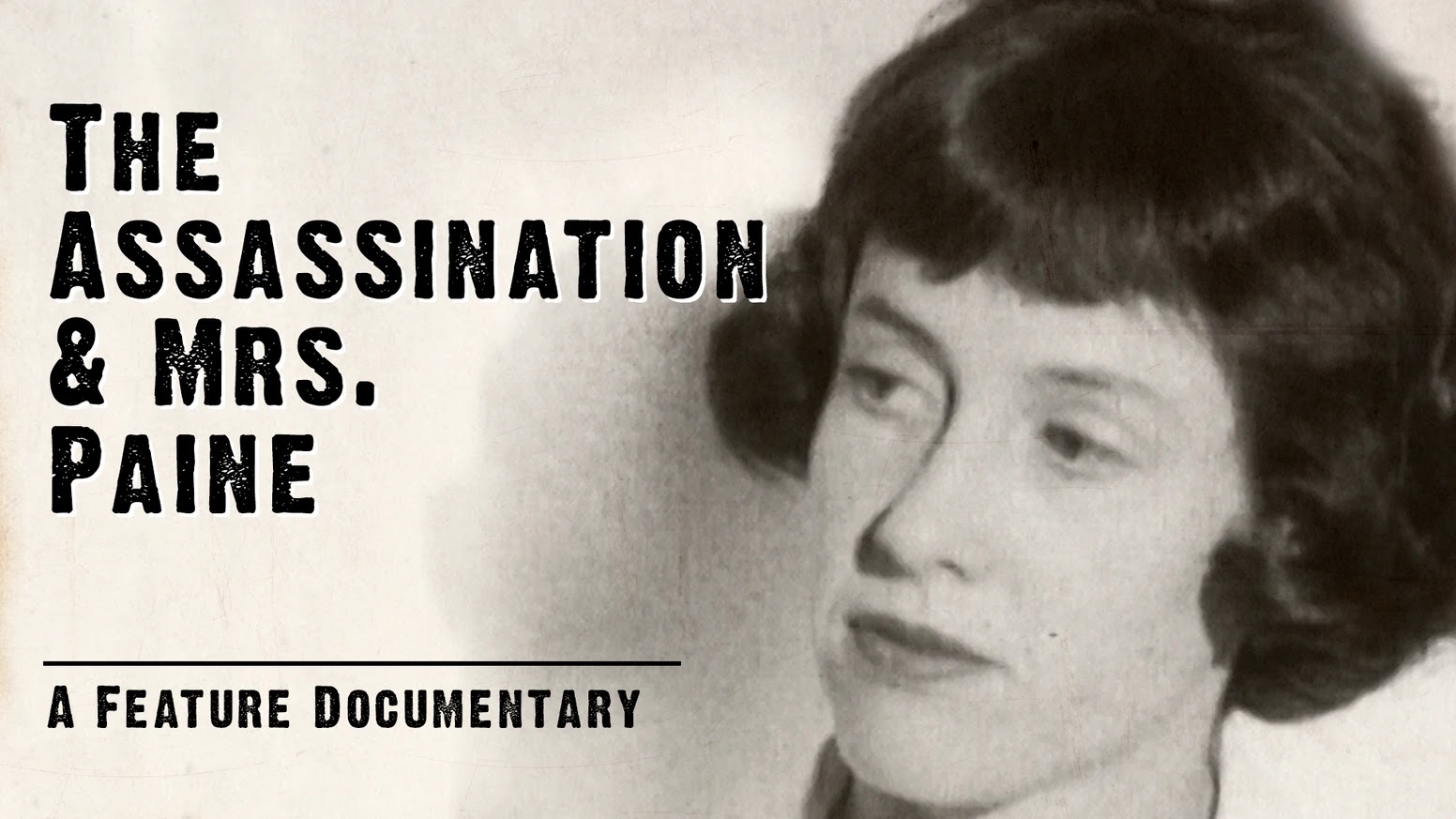
The Assassination and Mrs. Paine-The "Secret Files"

Max Good's award-winning film ends with the following dramatic claim reminiscent of Oliver Stone's JFK:

But Robert Reynolds, a professor in the Department of Foreign Languages and Literature at National Chi Nan University in Puli, Taiwan and an expert on the JFK Assassination Records Collection, looked into Good's claim. He told me in an email about his methodology (Reynolds' quotes are in green):

"I looked for the total number of files related to the Paines that are still withheld or redacted. My basis for this was the most recent update of the JFK database from NARA (May 2021). Here's how I looked for Paine-related files. I checked records where the title, subject, series name, comments or "file number" fields had the string "PAINE" anywhere in them. I then checked the same fields for the names "HYDE" (Ruth's family name), and for "HOKE" (the family name of Ruth's brother-in-law, John Hoke, who married Ruth's sister Sylvia). I also did the same for the name "Bielefeldt," a CIA employee who was apparently a friend of John Hoke's father. Finally, I checked FBI records for all docs with the case file numbers for Ruth Paine (105-126128) and Michael Paine (105-126129)."

Note that Reynolds omitted any tax-related files from his analysis since these are not subject to release by law. What was the result of Reynolds' research?

"I found lots of records using the name Paine, but only one document with the name Paine which still had redactions. This was a 12/05/63 memo. There are several copies of this memo in the ARC, here is an example. There is only one name redacted in this memo, someone on the CIA's Counterintelligence staff who provided info to the FBI about Ruth's father which they obtained during a 1950s investigation. That's it. For the name Hyde, only the 12/05/63 memo mentioned above came up with redactions."

"For the name Hoke, one more relevant record came up in the updated JFK database. Ruth's brother-in-law John Hoke applied for a position at the CIA and his application papers are in the ARC. This doc is a poor quality copy, but we can see that Hoke was not hired. The only redactions in this record are the names of a couple of CIA staff members who reviewed his application."

"Searching on the case file numbers for the Paines, there are four FBI records still redacted; three on the Paines' 1964 tax returns and one on their 1957 tax returns. These are redacted, not withheld in full according to the JFK database, so some of this material may be accessible. All the other records with the Paine case file numbers are released: 'open in full'."

"After my original post [to a JFK email group], I also found three more records relating to John Hoke that still have redactions, but which did not turn up in the Paine/Hyde/Hoke searches. These are 104-10120-10303 to 10305. These are all requests from CIA technical services to consult with Hoke, who at the time was employed in the Agency for International Development. To talk to him, they had to first get approval, and on these three forms the name of the person(s) who approved the request to consult with Hoke is redacted."

"Total: Ruth Paine: one document (multiple copies) has one name redacted. Michael Paine: zero documents redacted. John Hoke: four docs have CIA employee names redacted. All other documents for the Paines which are still redacted/withheld are tax related" (emphasis added).

My thanks to Robert Reynolds for his work on this matter. It would seem that Max Good should provide either links to the "dozens" of files he claims are "classified" or issue a clarification or retraction.

Addendum 1: Robert Reynolds just (6/4/22) sent me the following:

It has gone over my head all this time that the final screen of the Max Good film ends with a claim that "dozens of files related to the Paines remain classified." It is worth underlining that while the Paines' tax returns in the JFK collection are withheld from the public, they are NOT classified. ALL individual tax returns are withheld from the public, as mandated in the U.S. federal tax code. This has nothing to do with security classification (emphasis in original).

Addendum 2 (6/4/22): There has been talk on Internet forums about "other" documents besides those in the JFK Collection that remain unavailable to researchers. Robert Reynolds answered these concerns:

Two possible answers. They may be thinking of documents which are NOT held in the JFK collection at NARA. I can't say anything about those. It's a big world out there with lots of paper in it to write things down on.

IF they are thinking of documents in the JFK collection, that is a different story. The collection is known. It is numbered like the tribes of Israel in the Book of Numbers. Not every word in the collection is accessible to the public, but every word IS accessible to the people at NARA who have charge of the collection. (None of these people work for the CIA.)

What is not accessible to the public? There is a lot of confusion about this. There are documents withheld and documents missing and documents redacted. 515 records in the Collection are withheld. In full. With the exception of the Manchester interviews with JBK and RFK, all of these docs have been seen multiple times by the WC, the HSCA, the ARRB and those lucky dogs at NARA. They are almost all tax records.

There are 33 records in the collection that are "missing." There is a page up at NARA on these. If you believe NARA, nothing Paine related is there. If you don't believe NARA, please explain why. But you have to buy me a six pack of beer first.

NARA also says there are 14,236 records with redactions in the collection. People need to get this straight. These records are OPEN to the public in copies that have bits blanked out. Almost all of these were put online 2017-2018. You can look at them any time. I've looked at all of the CIA ones, some of the FBI ones. It was incredibly boring. The blanked bits are for the most part single names or locations. There is nothing there on the Paines. The bit blanking leaves more than enough context to show this. Look for yourself.

Friday, June 3, 2022

The Assassination and Mrs. Paine-Earl Warren

Introduction

Filmmaker Max Good tries to give the viewer the impression that his documentary, The Assassination and Mrs. Paine, tells both sides of her unique story. While Good does let Ruth Paine speak (and she frequently counters his assertions) he uses a mixture of standard conspiracy myths and his own misrepresentations to support the notion that Mrs. Paine and her husband Michael, who befriended Lee Harvey Oswald and his wife Marina, were working for the CIA. This shows that Good believed he had no marketable film without catering to die hard conspiracy believers, the majority of whom believe the men of Langley were behind JFK's murder. This series of articles will document the inaccuracies of the Good film and the sometimes mean-spirited way that Ruth Paine is represented.

Earl Warren

Good presents archival footage of Earl Warren and his fellow Warren Commissioners delivering their final report to President Johnson in September of 1964 (9:40). “In 1964,” Good intones, “Earl Warren was asked if the commission’s documents would ever be released to the public.” Good continues, “His answer? ‘Yes, there will come a time. But it might not be in your lifetime.” The uninitiated viewer is left with the impression that Warren made this statement at the time the report was issued and his remarks were indicative of his intention to withhold material. But that is not the truth.

Warren actually made his remark after the first day of testimony in February of 1964—not after the September release of the report. Warren’s full remark was “Yes, there will come a time—but it might not be in your lifetime. I am not referring to anything especially—but there may be some things that would involve security. This would be preserved but not made public.” Warren also indicated that nothing like this had yet turned up in the testimony of Marina Oswald who was then appearing before the commission. Author Vincent Bugliosi summed up the matter as follows in his landmark tome Reclaiming History:

This one remark, always quoted out of context, is the source of the belief that Earl Warren, knowing all the testimony and evidence that had been heard and gathered by the Warren Commission during its ten months of existence, had come to the conclusion that certain evidence should not be revealed to the American public for seventy-five years, and that he therefore ordered the sealing of the records for the subject period.

But Warren ordered no such sealing of records. Bugliosi noted that the Chief Justice wrote to Attorney General Katzenbach asking for “fullest possible disclosure of the materials” which were under jurisdiction of the National Archives. As early as July of 1966, approximately 80 percent of the records from federal agencies that had been turned over to the archives by the commission had been released. Today, the number of JFK documents released, including those identified as assassination records in the nineties by the ARRB, totals in the millions.

Monday, May 16, 2022

Thursday, April 21, 2022

Response to Kelly re: "HSCA Evidence of Conspiracy"

Researcher Bill Kelly recently published a blog article that attempts to debunk the “Lone Nut factoid” that “the only evidence of conspiracy that the HSCA came up with was the acoustical study, that has since been debunked.” Apparently because he is unhappy with my eBook, The Bishop Hoax, Kelly chose to focus his wrath on me.

Kelly writes:

Parnell tried to contest [Brian] Bennder’s (sic) mentioning the fact that the House Select Committee on Assassinations (HSCA) conclusion that there was probably a conspiracy in the assassination of President Kennedy, saying the only evidence of conspiracy that the HSCA came up with was the acoustical study, that has since been debunked.

The problem is, I never said this. What I did say is that the conclusion by the HSCA of a probable conspiracy was based primarily on the now debunked acoustic evidence.

The first draft of the HSCA report dated December 13, 1978, states:

The committee finds that the available scientific evidence is insufficient to find that there was a conspiracy to assassinate President Kennedy.

In his dissenting view to the final HSCA report (HSCA, 495), Robert W. Edgar noted:

Up to that moment in the life of the committee, we were prepared to go to the American people with that conclusion. Only after the report of Mark R. Weiss and Ernest Aschkenasy, in the 11th hour of our investigation, was the majority persuaded to vote for two gunman and a conspiracy. I respectfully dissented.

Indeed, the HSCA report listed four factors that led to the conspiracy conclusion:

(1) Since the Warren Commission's and FBI's investigation into the possibility of a conspiracy was seriously flawed, their failure to develop evidence of a conspiracy could not be given independent weight.
(2) The Warren Commission was, in fact, incorrect in concluding that Oswald and Ruby had no significant associations, and therefore its finding of no conspiracy was not reliable.
(3) While it cannot be inferred from the significant associations of Oswald and Ruby that any of the major groups examined by the committee were involved in the assassination, a more limited conspiracy could not be ruled out.
(4) There was a high probability that a second gunman, in fact, fired at the President. At the same time, the committee candidly stated, in expressing it finding of conspiracy in the Kennedy assassination, that it was "unable to identify the other gunman or the extent of the conspiracy.

But it is obvious that the first three factors listed by the committee were known to them at the time of the first draft and were not persuasive enough to lead to a finding of conspiracy. As noted by Edgar, it was only the “high probability” of a second gunman by way of the acoustics evidence that caused the committee to change its mind.

Kelly also notes that:

And the acoustical echo analysis, though often disputed, has never been debunked because the only way to prove or disprove a scientific study is to repeat it, and the HSCA acoustical echo analysis has never been duplicated.

Of course, this is nonsense. All that is needed is to show that the methodology of the original acoustics study was flawed and this has been done again and again. To date, the best summary of the problems with the acoustics data comes from Nicholas Nalli in his article The Ghost of the Grassy Knoll Gunman. Nalli draws on the work of noted acoustics critics including Dale Myers, Michael O’Dell and Steve Barber.

In addition to his misrepresentation of my position on the HSCA conspiracy findings, I have a few other problems with Kelly’s piece. He writes:

Parnell, one of the numerous die hard lone nutters who still try to contend the President was killed by a deranged loner for no apparent reason …

Again, I have never said that Oswald killed JFK for “no apparent reason.” In fact, I know of no “lone nutter” who has stated this. The Warren Commission did write that they “could not make any definitive determination of Oswald's motives.” Since Oswald was dead, this seems very reasonable. But they did, in fact, list several “factors” which “might have influenced his decision to assassinate President Kennedy.” They were:

  • His inability to enter into meaningful relationships with people, and a continuous pattern of rejecting his environment favor of new surrounding;
  • His urge to try to find a place in history and despair at times over failures in his various undertakings;
  • His capacity for violence as evidenced by his attempt to kill General Walker;
  • His avowed commitment to Marxism and communism, as he understood the terms and developed his own interpretation of them; this was expressed by his antagonism toward the United States, by his defection to the Soviet Union, by his failure to be reconciled with life in the United States even after his disenchantment with the Soviet Union, and by his efforts, though frustrated, to go to Cuba.

My own vote goes to “a place in history,” although any or all of these could be correct.

Back to Kelly as he turns his ire toward my book:

And a point that I don’t expect Parnell to address in his mythical interpretation of Antonio Veciana’s story, is how David Atlee Phillips, as Maurce (sic) Bishop, took Veciana to an office in the Pan Am Bank building in Miami in order to sign a security oath and begin his lessons in psychological warfare.

But Kelly has his Veciana stories mixed up, which is understandable considering their nonsensical nature. The training Veciana supposedly received was in Havana not in Miami. What was ostensibly at the Pan American building was a Knights of Columbus-like “commitment ceremony.” But the CIA has no such ceremony although they do have real agency employees sign a secrecy oath. But an examination of Veciana’s actual CIA paperwork created when he was an (unused) asset of sorts for a short period starting in 1961 shows no such oath and no evidence of CIA employment.

Finally, Kelly writes:

[Lopez and Hardway] also went to Mexico and wrote the long censored Lopez Report, that details many of the conspiracy leads that Parnell won’t even recognize. Both Lopez and Hardaway, to this day, are dedicated and proud conspiracy theorists.

Dan Hardway may or may not be a “dedicated and proud” conspiracy theorist. But he definitely is the person who became so skeptical of Veciana’s claims that he asked John Newman to look into them. Newman found that both the 1959 and 1960 stories of how Veciana met Bishop are false if you believe Bishop was David Phillips. Summing up, Kelly promises to “get to” my book with a rebuttal. That is fine with me, but I hope in the future he will not mischaracterize my views as he has done in this latest blog article.

Friday, March 18, 2022

The Bishop Hoax Released

Did anti-Castro activist Antonio Veciana really see Lee Harvey Oswald with CIA man David Atlee Phillips just weeks before the assassination of JFK? My new eBook—The Bishop Hoax: Fonzi, Veciana and the Making of a Conspiracy Myth—seeks to answer that question for all time.

In 1976, Veciana met with Congressional researcher Gaeton Fonzi for a series of three interviews. During those meetings, Fonzi reported that Veciana said that he met with a case officer code named Maurice (Morris at first) Bishop for thirteen years. It was Bishop who directed the anti-Castro efforts of Veciana and Alpha 66. Most significantly, before one of his meetings with Bishop, Veciana claimed he saw the mysterious mentor in the company of Oswald.

For twenty-five years, David Atlee Phillips was one of the most distinguished agents in the history of the Cold War CIA. In 1975, he retired to defend the agency from what he believed were unfounded accusations fueled by a media frenzy in the wake of Watergate. An unfortunate side-effect of the publicity Phillips garnered during his crusade was the accusation, based on Veciana’s statements, that he was “Maurice Bishop,” ran a secret campaign to assassinate Fidel Castro and was the “handler” of Oswald.

For over a decade, Phillips denied the charges and won two out of three lawsuits against individuals who promoted the Bishop story and related theories. But after Phillips died in 1988, a book was published by Fonzi titled The Last Investigation that popularized the Bishop story and became a classic JFK conspiracy text. Consequently, Phillips became one of the most popular suspects of CIA-did-it theorists who scrutinized every aspect of his career and added to the body of “facts” impeaching him. The notion that Phillips was Bishop became accepted by both JFK researchers and the public even though Veciana repeatedly denied that Phillips was Bishop over a nearly forty-year period.

The story underwent a demonstrable evolution from those initial interviews through Fonzi’s HSCA writeup, to his infamous 1980 article in the Washingtonian to his 1993 book. Finally, after Fonzi’s death in 2012, Veciana began a final revision of the narrative beginning with his 2013 claim that Bishop was Phillips after all and culminating with his dubious 2017 autobiography Trained to Kill. In that tome, Veciana abandoned all restraint and included virtually fictionalized accounts of the Bishop saga and supporting events.

Highlights of The Bishop Hoax include:

  • A biography of Veciana that shows what he really was doing during key periods of his life. Includes the formation and early history of Alpha 66, the 1961 and 1971 Castro assassination plots, the truth about his drug conviction, the “ambush in Reston” when Veciana and Phillips came face to face, the post Fonzi years and much more.
  • Why neither of Veciana’s stories about how he met Bishop could be true if Phillips was Bishop.
  • How Veciana tried to insert himself into historical events such as the Pedro Pan exodus.
  • Who was really running Alpha 66 in the years 1961-1965?
  • A profile of David Phillips focusing on the real human being rather than the caricature of him that has been popularized in conspiracy literature.
  • Phillips and Mexico City.
  • Phillips’ battles with conspiracy authors.
  • How Gaeton Fonzi deceived theorists for years by changing facts to fit his theories.
  • An analysis of the alleged Bishop-Oswald meeting.
  • Repudiations of numerous conspiracy theories, some of which come from other conspiracists.
  • An extensive summary of the book’s conclusions.

The Bishop Hoax makes a powerful case that the shadowy Maurice Bishop never existed. It was a narrative promoted by those that wanted to believe in a CIA conspiracy to kill JFK. That notion was then marketed to others with the same proclivity—including a former Washington Post editor. The resulting disinformation campaign went on for over forty years and sullied the reputation of a respected public servant and family man. The Bishop Hoax sets the record straight and finally puts one of the most enduring JFK myths to rest.

Thursday, March 10, 2022

The Bishop Hoax to be Released March 21st

I am pleased to announce that my eBook The Bishop Hoax: Fonzi, Veciana and the Making of a Conspiracy Myth will be released on March 21st free of charge right here on this blog. Four chapters (out of 30 total) will be released initially followed by one per week thereafter. The book, which consists of more than 110,000 words with over 1000 footnotes, is the result of five years of research and three years of writing. Stay tuned!

EDIT: Check out this teaser-Appendix A: The CIA and the Media 1960-1975.

The Bishop Hoax Now Available HERE

Thursday, January 20, 2022

Fact Check: whowhatwhy and JFK Revisited

Whowhatwhy has published a series on Oliver Stone's documentary JFK Revisited. The far-left publication maintains that, "Cleaning up the tangle of underbrush from our murky history can go a long way to establishing the primacy of carefully documented facts over lies, innuendo, and cover-up by all parties." Unfortunately, whowhatwhy is using disinformation in their attempt to "clean up" the verdict of history that Oswald was a lone gunman. Whowhatwhy's assertions are in block quotes followed by my rebuttal. Credit also goes to John McAdams, David Von Pein, Fred Litwin, Nick Nalli and Steve Roe whose work I have relied on.

… the Warren Commission report, with its urgency to rubber stamp J. Edgar Hoover’s non-investigation “investigation” that laid the tragedy solely at the feet of Lee Harvey Oswald, the “disgruntled loner seeking attention,” who bafflingly told police he did not do it. In fact, he declared himself “just a patsy.”

Whowhatwhy apparently does not realize that the prisons are full of "innocent" people. More importantly, Oswald lied throughout his life when it suited his needs. Including when he claimed he was a patsy.

Skeptics who accept the official account should consider the chain of custody surrounding the so-called “magic bullet” said to have passed through both Kennedy and Texas Gov. John Connally as they cruised in the presidential motorcade through Dealey Plaza.

Here is a report by David Von Pein on the chain of custody for bullet 399.

The civilian doctors who first examined the president at Dallas’s Parkland Hospital all saw an entrance wound in the throat — indicating that Kennedy was shot from the front, from the direction of the grassy knoll — that then “disappeared” from the military autopsy conducted at Bethesda Naval Hospital after Air Force One returned to Washington that night.

No wound "disappeared." The Dallas doctors, who were engaged in life-saving procedures and not trying to determine the nature of the President's wounds, indeed originally though the throat wound was an entrance. However, Malcolm Perry later admitted that was "just a guess" on his part based on the the relatively small size of the wound. The exact nature of the wound was never documented because the Dallas doctors performed a tracheotomy over the incision. However, both the HSCA and Clark Panel experts were able to discern remnants of the original exit wound despite the tracheotomy.

The president’s autopsy was Navy doctor J.J. Humes’s first-ever gunshot-wound postmortem. Though he had 40 observers on hand, Humes made sure to burn all his notes, a long-known fact to which JFK Revisited adds context.

Although he was an experienced and competent forensic pathologist, Humes admitted that he was not an expert on gunshot wounds. That is why he called in Pierre Finck to assist him. Regarding the autopsy notes, Humes explained, “The original notes which were stained with the blood of our late president, I felt, were inappropriate to retain to turn in to anyone in that condition. I felt that people with some peculiar ideas about the value of that type of material, they might fall into their hands."

One of the key primary witnesses supporting a conspiracy is John Stringer, the official autopsy photographer. He claims the photos of Kennedy’s blown-out head are fake, or at least altered. The type of film and camera used for these images are not the same camera and film as what he used that night. If Stringer didn’t take those pictures, who did? And why did they have to take another set?

This is a misrepresentation by whowhatwhy. Stringer never said any photos were faked or altered. When he was asked if anything about the photos caused him to question their authenticity. Stringer replied, "no." What he did say was he believed the photos of the brain were taken on a different film stock. But his memory of the events of 1963 was shaky since he was testifying over thirty years after the fact. Read Fred Litwin's report for more information.

As for Oswald, the accused assassin who was murdered two days later in a Dallas police station by mobbed-up nightclub owner Jack Ruby, three female witnesses who worked in the Texas School Book Depository independently claimed that he was not on the sixth floor at the time of the shooting (as Oswald maintained before his death).

Read Steve Roe's report on the matter.

And the gun found on the scene may not have been Oswald’s: The Mannlicher-Carcano rifle allegedly found in the sniper’s nest was 4.2 inches longer than the rifle Oswald purchased from a mail-order catalogue nine months earlier.

As David Von Pein explains:

"The likely explanation for why Oswald received a 40-inch rifle instead of the 36-inch model that he ordered via the Klein's mail-order coupon is pretty simple and logical, and it is this: Klein's very likely ran out of the 36-inch model shortly before receiving Oswald's order, and hence shipped a very similar (but slightly lengthier) gun instead."

Why was the street address of Oswald’s Fair Play for Cuba Committee in New Orleans scrubbed from post-assassination reports? Perhaps because the same office was a locus of anti-Castro activity — not Communist sympathizers, as Oswald was made out to be?

Oswald's FPCC chapter had no "street address" because it consisted of only Oswald himself. Oswald probably stamped "544 Camp" on a few pamplets to lend an air of authenticity to his fake group. See Fred Litwin's report on Guy Banister for more on 544 Camp.

Why was a “flash warning” removed from Oswald’s file at the FBI, just as Oswald returned from his alleged trips to the Cuban Consulate and Russian Embassy in Mexico City which otherwise would have alerted the Secret Service to consider him a security threat to the president?

As I noted here, there is no evidence of a connection between Oswald’s visit to the embassies in Mexico City and his removal from the watch list. FBI agent Marvin Gheesling told a superior that he removed Oswald’s name from the list after learning Oswald had been arrested in New Orleans. Gheesling went on to explain that he had previously forgotten to remove Oswald from the list but should have done so upon his return to the US in 1962 since the purpose of the “stop” on Oswald was to alert the FBI “in the event [Oswald] returned to the U.S. under [an] assumed name.” Gheesling was disciplined for his actions and he was not the only FBI agent whose foul-ups elicited punishment by the bureau. In a perfect world, the FBI would have monitored Oswald more closely and the tragedy in Dallas might have been averted.

Shortly before JFK’s scheduled arrival in Chicago on November 2, an ex-Marine sharpshooter named Thomas Vallee found himself arrested on the pretext of a minor driving offense. The FBI had placed Vallee under constant surveillance after receiving a tip from an informant identified only as “Lee” that Vallee was planning to assassinate the president.

Fred Litwin debunks the non-existent Chicago JFK plot in this article.

[JFK] prepared to withdraw a then-limited number of American troops from Vietnam, intentions reversed by Lyndon B. Johnson

One of the major problems that the media and historians have with Stone and DiEugenio is their insistence that JFK would have withdrawn from Vietnam to the exclusion of all other possibilities. But of course, no one can say for sure what JFK would have done.

[Ann] Hornaday cites “compelling evidence … that Garrison’s prosecution of Shaw was abetted and manipulated by intelligence agents in Moscow” and then she characterizes Oliver Stone’s filmic depiction of Shaw’s trial as “one of the most stunning successes of Soviet disinformation of the late 20th century.”

But it is a fact that Garrison was influenced by a series of articles in a communist-controlled newspaper called Paese Sera. Fred Litwin writes:

“The impact of the allegations leveled by Paese Sera on the New Orleans district attorney is beyond dispute. Garrison was in receipt of this scoop by no later than mid-March 1967. We know this via several contemporaneous sources, including the diary of Richard Billings …”

Litwin continues, “Insofar as Garrison was concerned, Shaw was now directly linked to the CIA, although the DA’s sole source was a newspaper clipping. In combination with the beliefs of conspiracy buffs, Garrison pivoted away from his initial theory of a locally-based, homosexual/sadism & masochism conspiracy and began talking in public about something much much bigger.”

... Clay Shaw lied throughout his trial, saying that he never in his life had ever worked for the CIA.

Fred Litwin, who has studied Clay Shaw extensively, makes the case that he was not a CIA operative in this article.

I [Peter Janney] submit that this debate [regarding Shaw's alleged CIA employment] ended in 1979 when CIA Director Richard Helms admitted under oath in a subsequent deposition (that involved E. Howard Hunt’s lawsuit with Liberty Lobby) the following:
The only recollection I [Richard Helms] have of Clay Shaw and the Agency is that I believe that at one time as a businessman he was one of the part-time contacts of the [CIA’s] domestic contact division, the people that talked to businessmen, professors, and so forth, and who traveled in and out of the country.

Janney is correct in this instance. Helms' description of Shaw as a domestic contact for the CIA is accurate. These were people who traveled extensively and provided information to the agency on a volunteer unpaid basis. They were loyal Americans not "CIA agents." Janney's use of Victor Marchetti, one of the most rabid of all CIA critics, is less convincing. Marchetti "believed" that Shaw was more than a "part-time contact" but provided no evidence to back up his claim. In any case, Marchetti was certainly not an unbiased source.

While the AP dutifully notes that the Warren Commission “concluded that Oswald had been the lone gunman,” the wire service ignores the conclusion of the House Select Committee on Assassinations (HSCA) that there was a probable conspiracy to assassinate President Kennedy.

But the HSCA agreed with the WC that Oswald had fired the shots that killed JFK. The HSCA conclusion of conspiracy was based on the so-called acoustics evidence. But that evidence has been debunked.

The theory that Oswald was a KGB asset has persisted for decades, despite a lack of evidence.

Any number of theories regarding the assassination have persisted for years despite a lack of credible evidence. But this installment of the whowhatwhy series is partly corrrect. Oswald was not a KGB asset. But neither was he a CIA agent or asset as whowhatwhy tries to show. Nor is there any credible evidence that the media is currently pushing a KGB-Oswald connection to cover up a CIA plot to kill JFK.

[The KBG theory] ignores the many signs that suggest Oswald may indeed have been an intelligence asset — but the CIA’s, an agency whose very existence was threatened by John F. Kennedy.

The notion that JFK wanted to destroy the CIA is one of the most poorly supported ideas in the long history of JFK theorizing. The concept is based on one unverified quote from the New York Times. But as Fred Litwin reports, instead of moving to destroy the CIA, Kennedy started using the agency to further his anti-Castro agenda after the failed Bay of Pigs invasion.

Circumstantial evidence suggests Oswald was recruited into the US intelligence community while in the Marines. Through this lens, everything Oswald did, including learning Russian while a teenaged Marine and “defecting” to the Soviet Union at 19 in 1959, was carefully choreographed.

The "circumstancial evidence" reffered to is weak at best. It consists of things such as Oswald owned a Minox "spy camera" and had written "microdots" in his notebook. Also mentioned in the link used by whowhatwhy to support their assertions is the "special training" Oswald must have had to learn the Russian language. But Oswald learned to speak Russian by neccessity since he had to use it in order to communicate with just about anyone including his wife Marina.

Infuriated, Oswald left [Mexico] for Texas on October 2 to plot the crime of the century.

The liklihood is that Oswald never developed a plan to shoot JFK before November 19. That is the date that the motorcade route was first published in newspapers.

The purpose of his visit, we are told, was to obtain transit visas from the Cuban Embassy in order to return to the USSR, where Oswald lived from October 1959 to June 1962. There he was, hoping to go back, even though he had gladly fled the totalitarian state and publicly expressed how happy he was to be living in the US again.

But there are indications that Oswald wanted to get to Cuba. JFK expert Gerald Posner told author Steven Gillon that following the assassination Oswald, “was on his way back to Mexico City and the Cuban consulate.” Posner went on to say that Oswald "only wanted to get to Cuba, where he thought the real revolution was happening. Cuban bureaucrats in Mexico City had refused him a visa to Havana only a month earlier. He intended to show up and say, ‘This is what I’ve done,’ and they would have no choice but to enthusiastically embrace him.”

There are some indications that Oswald did travel to Mexico City ...

The evidence is overwhelming that Oswald was in Mexico City and includes his photo and signature on documents, statements of witnesses, CIA surveillance and Oswald's own admissions that he was in the Mexican capital.

Speaking in broken Russian — which Oswald spoke nearly fluently — a caller identifying himself as Oswald to the Soviet official on the other end of the line sought more information about his visa request.

The possibility exists that Oswald could have been impersonated by the CIA. The reason for such an impersonation would be an attempt by the agency to see what Oswald was doing or where he was. It is known that such a technique was used by the CIA in Mexico City previously. If the agency were using such a gambit it would indicate a lack of knowledge on their part about Oswald rather than point to their use of him as an asset.

CIA surveillance cameras photographed everyone entering or leaving the Soviet and Cuban embassies in Mexico. Why have they never produced one single photo of Oswald even though he reportedly made several visits between the two buildings? The only photos to appear are of this “Mexico City Mystery Man,” as he has been dubbed. Was he the mystery man pretending to be Oswald on the phone?

This is another "mystery" that has been explained to theorists for years that they simply refuse to accept. The cameras were somewhat prone to breaking down and did not provide continous coverage. The ARRB studied the issue and found in regards to the Cuban embassy that a “Robot Star” camera with a trigger device as well as a K-100 camera were installed on the very day that Oswald arrived in Mexico—September 27th. The Robot Star was to be tested for four days and the K-100 for an additional four days. But no photographic take from these cameras was produced. The ARRB noted that one explanation for this lack of coverage was that a camera was focused on a shaded area instead of the door of the consulate. Additionally, the ARRB said that the mere presense of dark clothing could fool the system.

The CIA knew Kostikov as a spy, thought to be involved in all the craft’s darkest arts. A notorious foreign intelligence agent meeting with a former defector to Russia should have set off alarm bells. Yet the CIA chose to keep this information to itself.

As I noted here, Kostikov was working in the Soviet embassy under the cover of a consular officer. The fact is anyone who had business of any sort at the embassy might come into contact with him.

In conclusion, whowhatwhy claims that "There have been no good answers to such troubling questions." But the answers have been there for many years in most instances. For reasons known only to them, whowhatwhy and others simply do not want to accept those answers.

Powered by Blogger.